Why Is My Engine Knocking When Accelerating?
Top summary answer
Engine knocking when accelerating is usually spark knock (detonation) caused by low-octane fuel, carbon build-up, or a faulty knock sensor — but if the noise is a deep double-tap that tracks engine speed, it is rod bearing wear and the engine is near the end of its life. Timing and tone decide which one you have.
What does engine knocking actually sound like?
Knocking is a metallic rattle or tap from the engine that follows the rhythm of the cylinders. Under acceleration it either rattles like a tin of gravel (spark knock) or taps twice, low and heavy, like a hammer on the block (rod knock).
This is the first thing we ask a customer on the phone, because the two noises come from completely different problems. Diagnose first, then shop: buying on a noise alone is how people pay twice. Across my seventeen years diagnosing these, the description of the sound has told me more than any scan-tool printout.
Spark knock — detonation — is the air-fuel mixture igniting too early or in more than one place at once. It sounds like light rattling or marbles on a metal tray, and in most cars you hear it for a second or two under acceleration, especially uphill or with a load.
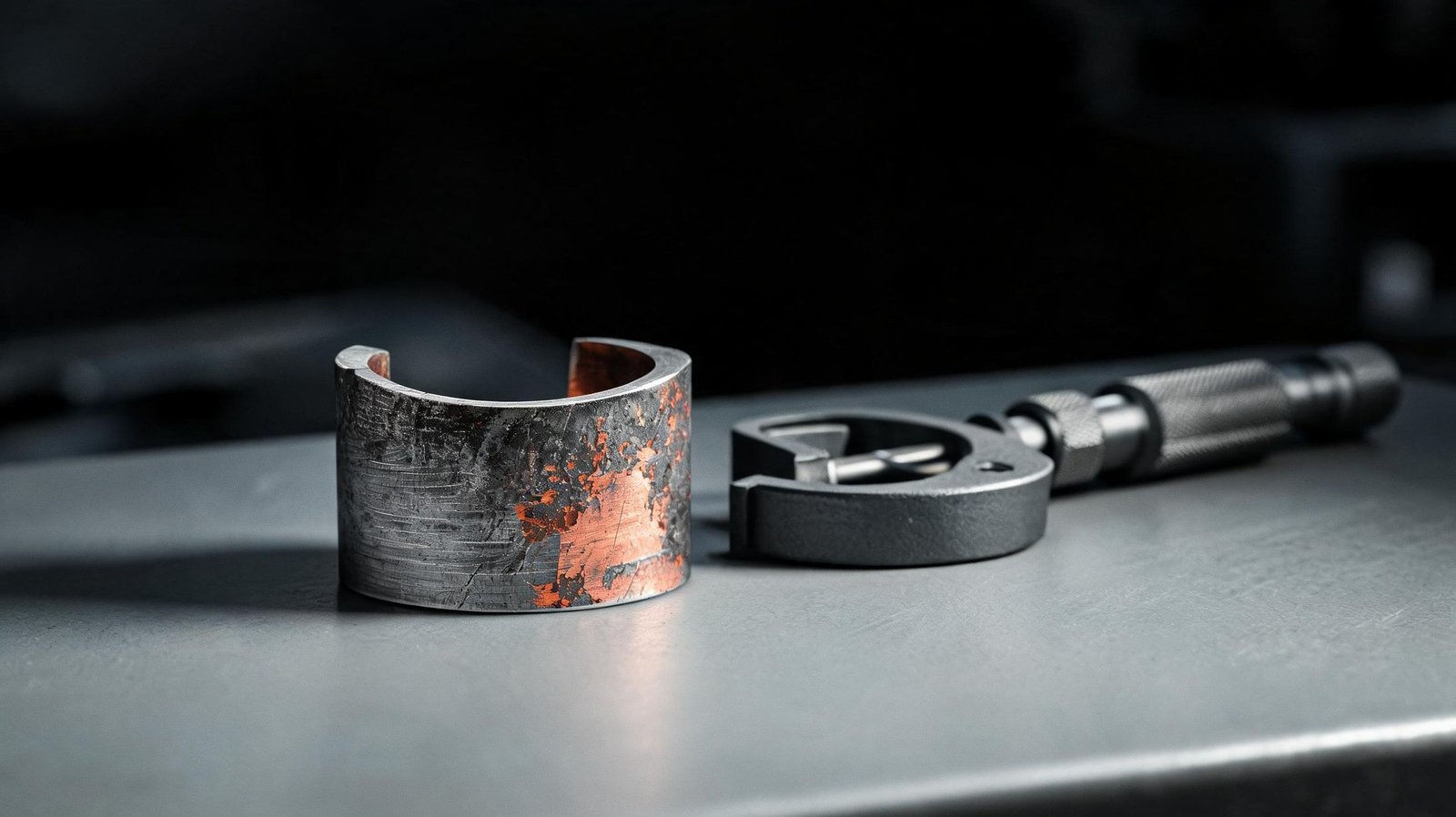
Rod knock is mechanical. The bearing clearance on a connecting rod has opened up, so the rod is physically striking the crankshaft journal. That noise is a dull, heavy double-tap from the lower half of the engine. It does not come and go — it is there at idle, and it gets faster and louder as RPM rises.
- Light rattle under load, quiet when cruising → spark knock
- Heavy double-tap from the bottom end, always present → rod knock
- Ticking that speeds up with RPM but stays light → lifter or valve train
- Hollow slap when the engine is cold that fades when warm → piston slap
- Rattle plus a check-engine light and rough idle → often a timing-chain or cam-phasing fault, not a bearing
What does detonation mean, and what causes it?
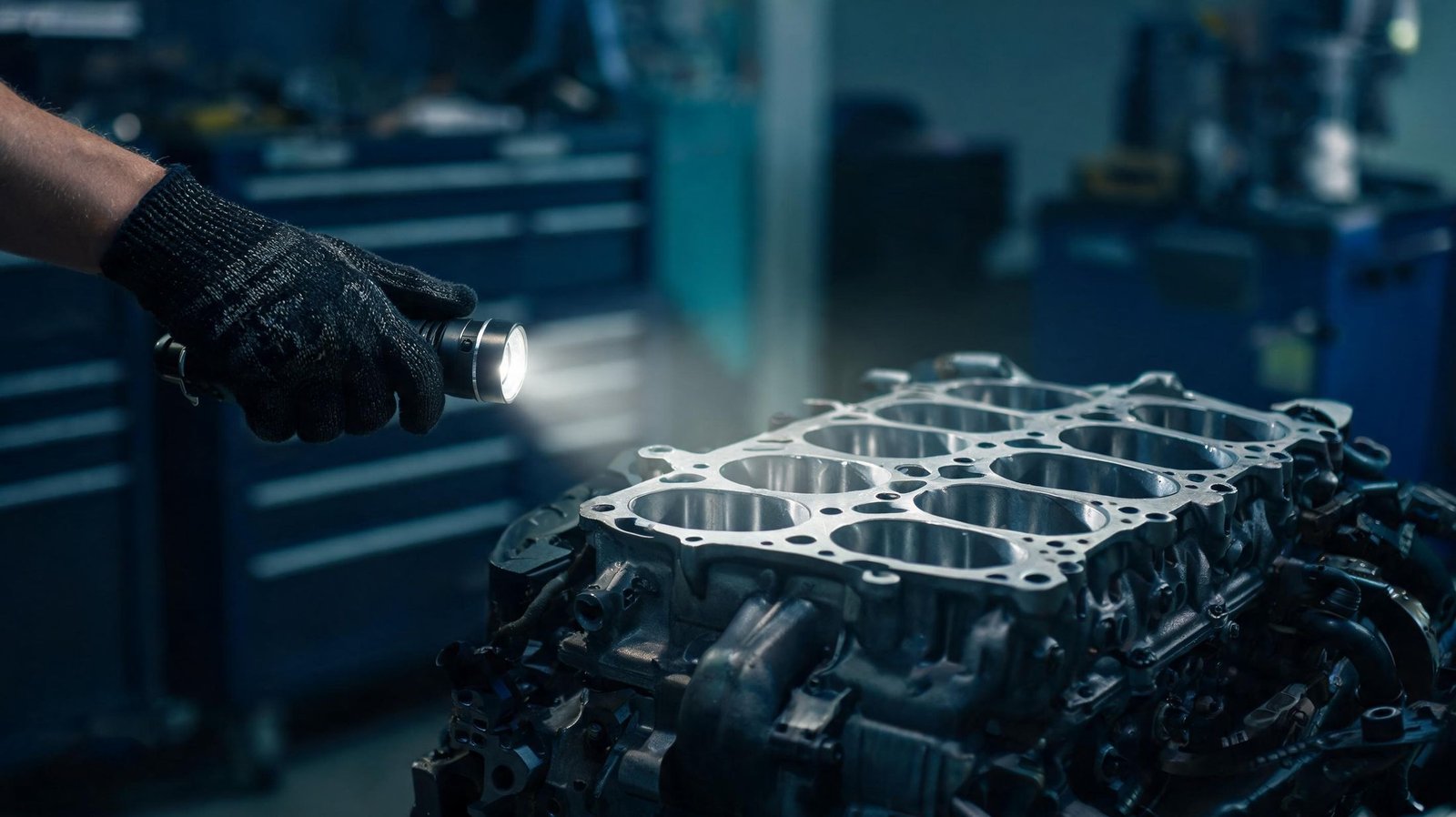
Detonation is the fuel-air charge burning unevenly — igniting before the spark or in several places at once — so pressure spikes instead of rising smoothly. It is caused by low-octane fuel, carbon build-up, high intake temperature or too much ignition advance.
In a healthy engine the flame front travels across the chamber in a controlled burn. In detonation, the end gas ignites on its own before the front arrives, and two pressure waves collide. You hear that collision as a rattle.
The engine computer normally protects you here. When the knock sensor hears detonation it pulls ignition timing back. If the sensor has failed, is loose, or is not torqued correctly, the computer cannot hear the knock and cannot protect the engine — so the noise reaches the driver.
Combustion behaviour and the octane question are worth reading up on at the EPA vehicle and fuel emissions testing pages. On modern turbocharged direct-injection engines there is a second, rarer pattern called low-speed pre-ignition (LSPI), where the charge ignites before the spark at low RPM under high load. It is violent enough to crack pistons, and manufacturers specify oils with the correct LSPI rating for exactly that reason.
- Low-octane or stale fuel — the most common cause we see after a fill-up at an unfamiliar station
- Carbon build-up on pistons and valves, which raises the effective compression ratio — common on direct-injection engines
- Engine running hot: a partially blocked radiator, a failing thermostat or low coolant
- A failed, loose or incorrectly torqued knock sensor, or a wiring fault to it
- Incorrect spark plugs or the wrong heat range fitted at the last service
- A lean condition from a vacuum leak, dirty mass-airflow sensor or weak fuel pump
- Turbocharged engines running high load at low RPM — the LSPI window
What causes knocking when you accelerate?
Acceleration is when cylinder pressure and temperature peak, so anything marginal shows up first under load: fuel octane, carbon deposits, cooling performance, spark plugs and the knock-sensor circuit. Mechanical knock is different — worn rod bearings, worn wrist pins or a loose timing component.
When you put the engine under load, the computer adds fuel and advances timing to make power. If the fuel cannot tolerate that timing, or the chamber is hotter than it should be, detonation appears at exactly that moment.
This is why the fault follows the driving condition rather than the engine speed. A car can idle all day without a single rattle and knock the moment it pulls a trailer up a hill.
| Condition | Most likely cause | Typical fix |
|---|---|---|
| Only with cheap/low-octane fuel | Detonation (spark knock) | Use the recommended octane, clean the fuel system |
| Only when the engine is hot | Overheating or carbon build-up | Cooling-system repair or an induction clean |
| Only under heavy load / towing | Lean mixture or knock-sensor fault | Diagnose fuel trims and the knock-sensor circuit |
| Constant, louder with RPM, present at idle | Rod bearing wear | Engine replacement, not a repair |
| Present when cold, fades when warm | Piston slap | Monitor; replace if oil consumption rises |
| Rattle with rough idle + code P0016/P0017 | Timing chain stretch or VVT fault | Timing-component repair |
Is it rod knock, spark knock or something else?
They sound similar in a message but they are four different faults: spark knock is ignition, rod knock is a bearing, lifter tick is the valvetrain, and piston slap is bore wear. The fuel and repair bills are completely different, so name the noise before you spend.
Spark knock (detonation) is a light, fast metallic rattle that appears under load and usually stops the moment you lift off — fuel, carbon or a knock sensor can be the cause. Rod knock is the opposite character: a heavy, slow double-tap from the bottom end that keeps time with engine speed and gets worse as the engine warms. Lifter tick is a dry top-end click heard mainly on cold start, and piston slap is a hollow rattle when cold that fades as the pistons expand.
One more impostor: an exhaust heat shield, a failing belt tensioner or a loose accessory bracket can all buzz under acceleration and send drivers engine-hunting for nothing. When the diagnosis does land on the bottom end, replacement is usually the honest answer — for example a used Ford F-150 engine for sale with the Coyote 5.0 V8, or a reconditioned Chevrolet Silverado engine for sale with the L84 5.3L V8.
- Spark knock: light rattle, only under load, quits when you lift off — fuel and ignition territory.
- Rod knock: heavy double-tap, follows RPM, worsens hot — bottom-end bearing territory.
- Lifter tick: sharp top-end click, loudest on cold start — valvetrain territory.
- Accessory rattle: buzz from belts, pulleys or heat shields — the cheap end of the list.
- Codes are not interchangeable: the Coyote 5.0 is Ford's modern double-overhead-cam V8, nothing like the older pushrod 5.0 — and the L84 is the current 5.3-litre with Dynamic Fuel Management, not the earlier L83.
How do I tell spark knock from rod knock?
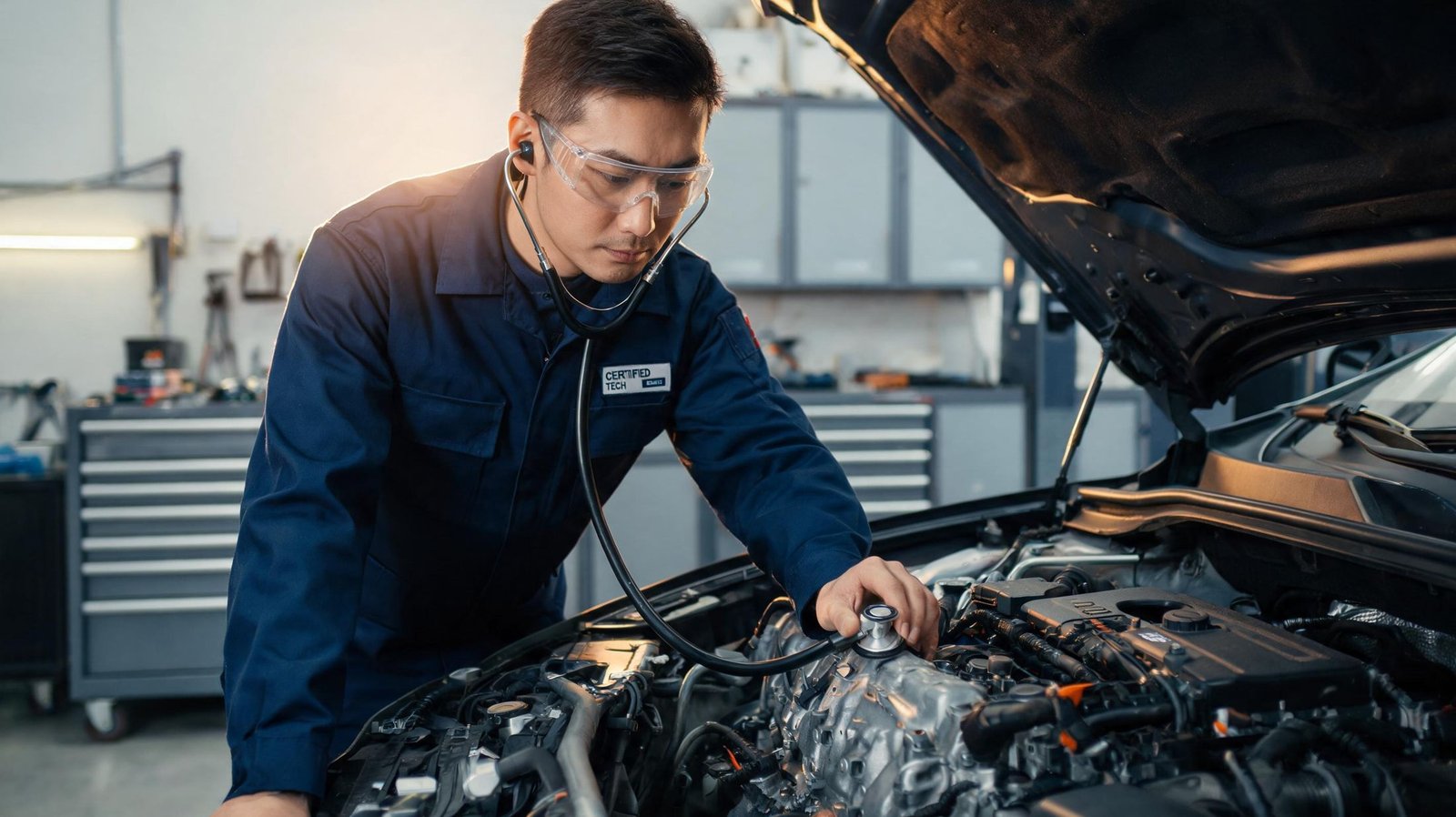
Use a stethoscope or a long screwdriver as a probe: spark knock is loudest at the top of the engine near the cylinder head, rod knock is loudest under the block near the oil pan. Then check the oil for metal debris and read the knock-sensor codes.
We use a three-part check, and it is the same sequence we recommend to any owner before they spend money. None of it involves holding the car against the brakes — that loads the transmission and brakes far harder than the drivetrain was designed for and can cause damage on its own.
First, listen with a probe and map where the noise is loudest. Second, drain a small amount of oil through a clean rag and look for a metallic sheen — bearing material glitters like fine paint. If the dipstick has also been dropping between services, work out the oil consumption first — starvation is often the chapter before the noise. And when the noise is already present, our rod knock or lifter tick guide settles which end of the engine is talking before anything is ordered. Third, read the codes: an active knock-sensor circuit code (see the engine code index) changes the diagnosis completely because the engine may simply be unable to protect itself.
If you are not certain after those three steps, do not guess. A short road test with a workshop listening for the noise — or a five-minute inspection on a lift — is far cheaper than a replacement engine bought because a noise was misread.
- Probe test: locate the loudest point — top end (valve train) or bottom end (bearings)
- Oil check: drain a sample through a clean rag and look for a metallic sheen
- Code check: read stored and pending codes, especially the knock-sensor circuit, and look for misfire counters on individual cylinders
| Characteristic | Spark knock | Rod knock | Lifter tick | Piston slap |
|---|---|---|---|---|
| Timing | Under load only | Always | Cold start, often fades | Cold, fades when warm |
| Location | Top of engine | Bottom-end, oil pan | Valve cover | Upper block |
| Changes with RPM | Disappears when you lift off | Frequency rises with RPM | Faster but light | Fades as it warms |
| Affected by octane | Yes — usually stops | No | No | No |
| Oil debris | None | Metallic sheen | None | None |
| Severity | Repair | Replacement | Repair | Monitor |
Which knock sensor codes point to this problem?
A knock-sensor circuit fault usually appears as P0325 (sensor 1 circuit), P0326/P0327/P0328 (range, low, high) or P0330–P0334 on the second bank. If one of those codes is stored, fix the sensor circuit before condemning the engine.
This is the pattern we see most often in the shop: a car arrives with a knock complaint and a P0325 in history. The owner has already been told the engine is finished. In reality the sensor was not reading, the ECU stopped retarding timing, and the engine was detonating purely because it could not hear itself.
A knock sensor code P0325 means the ECU has lost that microphone. The sensor itself is a piezoelectric element bolted to the block — on a BMW B48 it sits under the intake manifold, which is why the wiring is so often disturbed during other work. It must be torqued correctly — over- or under-tightening changes its output — and its shielded wiring must not run near ignition leads. We have solved more knocking complaints with a sensor and a torque wrench than with any parts order.
The exception is when the sensor is working, there are no fault codes, and the noise is a bottom-end double-tap with metal in the oil. That is mechanical, and no sensor will fix it.
| Code | Meaning | First action |
|---|---|---|
| P0325 | Knock sensor 1 circuit malfunction | Check connector, shielding and mounting torque |
| P0326 / P0327 / P0328 | Sensor 1 range / low input / high input | Verify sensor output and wiring continuity |
| P0330–P0333 | Knock sensor 2 circuit faults (V engines) | Same checks on bank 2 |
| P0332 / P0334 | Sensor 2 low / high input | Check for water ingress in the connector |
Is it safe to keep driving with a knock?
Spark knock should be diagnosed within days — prolonged detonation can hole a piston. Rod knock means the engine can fail completely without warning, so the car should be driven as little as possible until it is assessed.
If it is a light rattle only under acceleration, you can drive gently and get it looked at this week. Avoid towing, avoid hard acceleration, and keep the tank on the recommended octane.
If it is a bottom-end knock, the risk is a broken rod that exits the block. At that point a repairable core becomes scrap metal, and the repair bill moves from a bearing job to a replacement engine plus a damaged block. Every mile you drive increases that risk.
If the oil-pressure light flickers at idle along with the knock, switch the engine off as soon as it is safe to do so and have the car recovered. That combination is the classic end-stage pattern.
- Light rattle, only under load → safe for short journeys; book a diagnosis
- Heavy double-tap that follows engine speed → stop driving and have it assessed
- Knock plus low oil-pressure light → switch the engine off as soon as it is safe
- Knock plus overheating → do not continue driving; you risk warping the head
- Knock plus a misfire code → avoid driving; raw fuel is washing the bores and diluting the oil
What does it cost to fix — and when is a replacement engine the better call?
A knock-sensor, plug or carbon-clean repair typically costs $150–$600 in parts and labour. A bottom-end rebuild usually runs $2,500–$5,500, while a tested replacement engine is typically $900–$3,500 delivered depending on the unit — which is why replacement often wins on a high-mileage engine.
These are the ranges we see across the makes we supply, and they are the numbers we use when we talk a customer through the decision. Your local labour rate and engine access will move them.
A rebuild of a worn bottom end means the engine comes out, is stripped, the crank is machined, and the whole assembly is re-measured. On a high-mileage unit that often costs more than a tested replacement — and you still have the original block's history.
We sell engines, so treat this paragraph with the scepticism it deserves: our honest rule is that a car worth keeping with a healthy top end and a good body deserves the cheaper of the two paths, whichever that is.
| Path | Typical cost | Best for |
|---|---|---|
| Fuel/octane or carbon treatment | $150 – $350 | Light spark knock with no mechanical noise |
| Knock sensor replacement (with diagnosis) | $250 – $600 | Knock present with a P0325-family code |
| Cooling-system repair | $300 – $1,200 | Knock only when hot |
| Bottom-end rebuild | $2,500 – $5,500 | Rare, matching-numbers or classic engines |
| Tested used engine (fitted by your shop) | $900 – $3,500 + labour | Daily drivers, high mileage |
| Reconditioned / remanufactured engine | $2,000 – $6,000 + labour | Keepers, work vehicles, long-term cover |
| Tier | Warranty (whichever comes first) | What is covered | Best for |
|---|---|---|---|
| Used | 9 months / 6,000 miles | The supplied unit | Lowest cost, daily driver |
| Reconditioned | 16 months / 12,000 miles | Unit plus replaced service parts | Balanced cost and cover |
| Remanufactured | 36 months / 36,000 miles | Unit rebuilt to specification | Long-term keepers and work vehicles |
How do I make sure a used engine does not knock before I buy it?
Ask for the engine code, insist on compression results and a run test, and buy from a supplier that verifies fitment against your VIN before dispatch — not one that sells from a generic listing.
This is the part I argue about most often with buyers, because it is where a cheap engine gets expensive. A used engine is a mechanical part with a history; the value is in the testing, not the mileage figure alone.
Every unit we dispatch is compression-tested, and run-tested where the unit allows. The engine code is matched to your VIN range before it ships (decode it yourself with the NHTSA VIN decoder), which is why we quote per vehicle instead of from a flat price list — you get nine price options across the three condition tiers and three warranty lengths.
If a supplier cannot tell you the engine code of the unit they are selling, stop the conversation there. That single question separates a parts broker from a supplier who has actually looked at the engine.
- Insist on the engine code — not just the make, model and year
- Ask for compression results, not a verbal 'it runs fine'
- Confirm the warranty tiers and exactly what they cover
- Check that the supplier verifies fitment against your VIN
- Confirm freight is insured, so transit damage is not your loss
What should I do next?
If the knock is a light rattle, book a diagnosis this week and start with fuel, plugs and the knock-sensor circuit. If it is a bottom-end double-tap with metal in the oil, plan for a replacement and compare the used, reconditioned and remanufactured tiers before you commit.
Either way, do not drive on a bottom-end knock while you decide — and read the shipping policy and returns terms before you order, so the freight and return side is clear from the start. A seized bearing can turn a recoverable core into scrap and take the block with it.
If you already know you need a replacement, start with your engine code — that single detail decides which units physically fit, and it is the first thing our fitment desk asks for.
How do I check which engine fits my vehicle?
Enter your VIN or engine code in the fitment lookup and we match the code to your vehicle before you see a price — the same check our fitment desk runs by hand.
Reading a code off a sticker is fine; confirming it against the VIN range is what prevents a return. On the get your price page the lookup takes your vehicle details, then returns nine options across the three condition tiers — that is three condition grades multiplied by three warranty lengths.
If you would rather have it checked for you, decode the VIN first with NHTSA's free decoder and bring both numbers to the call.
- VIN or engine code in → matched unit out, before any price is shown
- Nine options = 3 condition tiers × 3 warranty lengths
- Freight free and insured, 12–16 working days USA-wide
- If the code is ambiguous on your platform, a specialist confirms it before dispatch
What do these terms mean?
Plain-English definitions of the technical terms used in this guide, so you can follow the diagnosis without a workshop dictionary.
Octane Rating — Octane rating measures how much a fuel resists igniting under pressure — higher octane resists detonation better, which is why a marginal engine stops knocking on premium.
Pinging — Pinging is the driver’s word for spark knock: a light metallic rattle heard under acceleration when the fuel-air charge ignites unevenly.
Engine Teardown — An engine teardown is stripping the unit down to the block and rotating assembly to measure bearings, bores and journals — the only way to price a rebuild honestly.
Compression Test — A compression test cranks each cylinder and records the pressure it produces; cylinders should read within about 10 per cent of each other, and a low cylinder points at rings, valves or a gasket.
Where do these figures come from, and where can I verify them?
The price ranges, test procedures and thresholds in this guide follow standard trade practice and the public technical resources below. You can verify the background yourself:
Ranges are typical US independent-workshop figures and our own condition and warranty tiers — treat them as guidance, not a quote for your vehicle. A2Z Engines is the trading brand of QB AUTOZ LLC, a Mississippi-registered supplier — the company record is on our about page.
- EPA vehicle and fuel emissions testing — how combustion faults and octane affect emissions results.
- API Engine Oil Matters — why the oil specification on the filler cap matters on detonation-prone engines.
- FuelEconomy.gov — the official DOE and EPA fuel economy resource.
Which related guides should I read next?
These are the guides we hand to customers at the end of this conversation — each one picks up a thread from this post and finishes it.
- Rod Knock or Lifter Tick: How Do I Tell? — the companion guide that separates a bottom-end knock from a harmless top-end tick.
- How Much Oil Consumption Is Normal? — the wear story that so often comes before a knock starts.
- What Does a P0301 Misfire Code Actually Prove? — when the noise arrives with a fault code attached.
- Explore the site: shop by make · engine code index · used engines · transmissions — every unit fitment-checked before dispatch.
- Ready for numbers? Get your price — nine options across three condition tiers — or search the full catalogue; more guides live on the blog index.
Frequently asked questions
Does engine knock mean my engine is ruined?
Not always. Light knock under acceleration is usually detonation and is often fixed with the correct fuel, new plugs or a knock-sensor repair costing $150–$600. A heavy bottom-end knock means the engine is at the end of its life — compare used engines for sale before you commit.
Can I drive with a knocking engine?
With light spark knock, yes — gently and briefly, while you arrange a diagnosis. With a heavy double-tap from the bottom end, no: a rod can break through the block without warning.
Does premium fuel stop engine knock?
Premium fuel stops detonation in engines that are otherwise healthy but marginal on octane. It will not mask rod knock, piston slap or a mechanical fault, and it is not a diagnosis.
Why does my engine only knock when I accelerate?
Because acceleration is when cylinder pressure peaks. A marginal fuel, carbon build-up or a failed knock sensor shows up under load long before it appears at idle.
Can bad spark plugs cause engine knock?
Yes. The wrong heat range, an incorrect gap or a plug that is breaking down under load can trigger detonation and misfires that sound like knock. Plugs are the cheapest thing to rule out first.
What does a P0325 code mean?
P0325 is a knock-sensor-1 circuit malfunction. The sensor is not reporting, so the ECU may stop retarding timing — fix the circuit before condemning the engine.
How much does it cost to fix an engine knock?
Spark knock is usually $150–$600 (fuel, plugs, sensor, carbon clean). Bottom-end knock is normally solved with a replacement: a tested used engine typically runs $900–$3,500 plus labour, and a remanufactured unit $2,000–$6,000 plus labour.
Will a used engine knock after I fit it?
It should not. A tested unit with recorded compression results and a warranty is the protection; our used tier alone carries 9 months or 6,000 miles, whichever comes first.
What does this code actually mean?
The code tells you which cylinder is under-performing and how the ECU measured it — it does not name the faulty part. Coil, plug, injector, wiring and compression all produce the same code, which is why the swap test and a compression check come before any parts.
What should I know about rod knock vs spark knock?
Rod knock is a heavy bottom-end double-tap that follows engine speed; spark knock is a light top-end rattle that appears only under load and stops when you lift off.
What should I know about engine detonation causes?
Detonation comes from low-octane fuel, carbon build-up raising compression, an overheating engine, over-advanced timing or a knock sensor that has stopped reporting.
What should I know about low speed pre-ignition LSPI?
LSPI is pre-ignition at low RPM under high load on turbocharged direct-injection engines — violent enough to crack pistons, which is why the correct low-LSPI oil specification matters.
What should I know about timing chain rattle?
A stretched timing chain or a failing tensioner rattles on cold start and can set cam-timing codes — it sounds metallic but it is not a bearing knock.
Check your fitment and see nine price options
Enter your VIN or engine code — we match the unit to your vehicle before any price is shown. Nine options means three condition tiers across three warranty lengths.
Get my price Call +1 (662) 452-4928