What Does a P0301 Misfire Code Actually Prove?
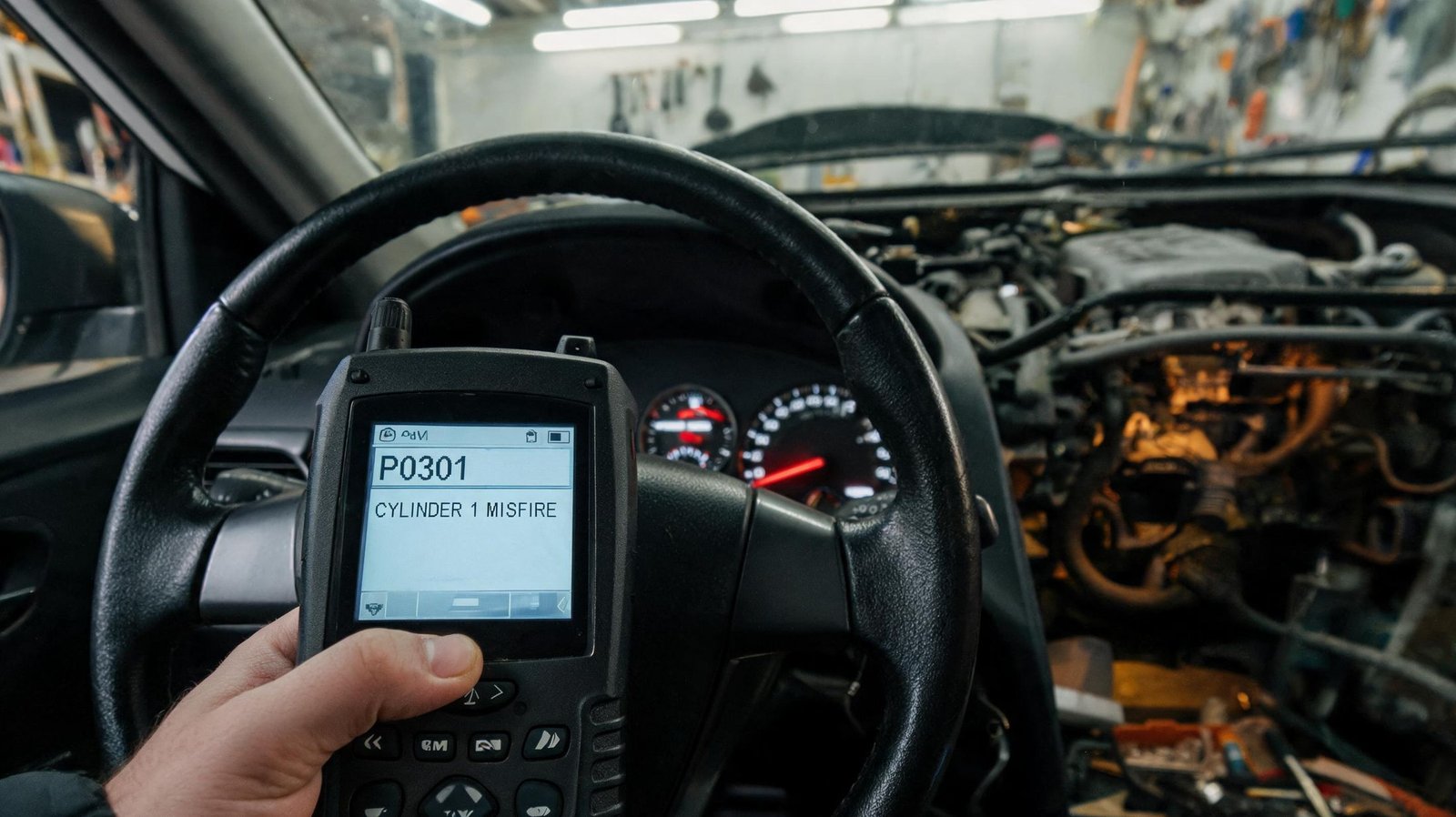
Top summary answer
A P0301 misfire proves one thing: cylinder 1 is not contributing its share of power. It does not prove why. Roughly four in five P0301 codes we see are ignition or fuel faults — coil, plug, injector or wiring — and only a compression or leakage test can prove the fault is mechanical.
Why is my engine shaking and the check engine light flashing?
A flashing check-engine light means the misfire is bad enough to damage the catalytic converter — raw fuel is reaching the exhaust and burning there. Stop driving hard, get the code read, and treat a flashing light as urgent rather than a warning.
This is the phone call we get most often: the truck starts shaking at idle, the light comes on and then starts flashing, and the driver wants to know whether the engine is finished. Nine times out of ten it is not.
Owner complaints that come with a P0301 are consistent — rough idle, a shudder at low speed, a noticeable loss of power uphill, and a fuel smell at the tailpipe. On some vehicles the transmission shifts oddly too, because the computer is compensating for a cylinder that is not pulling its weight.
The flashing part matters. A steady light says 'fix this soon'. A flashing light says 'stop, the converter is being cooked'. If yours is flashing, keep the revs low and get it looked at the same day.
- Rough idle or a shaking engine at low speed
- Loss of power and worse fuel economy
- Fuel smell at the exhaust, sometimes a pop from the tailpipe
- Harsh or delayed shifts while the ECU compensates
- Flashing light = catalytic converter at risk — treat as urgent
What does P0301 actually mean?
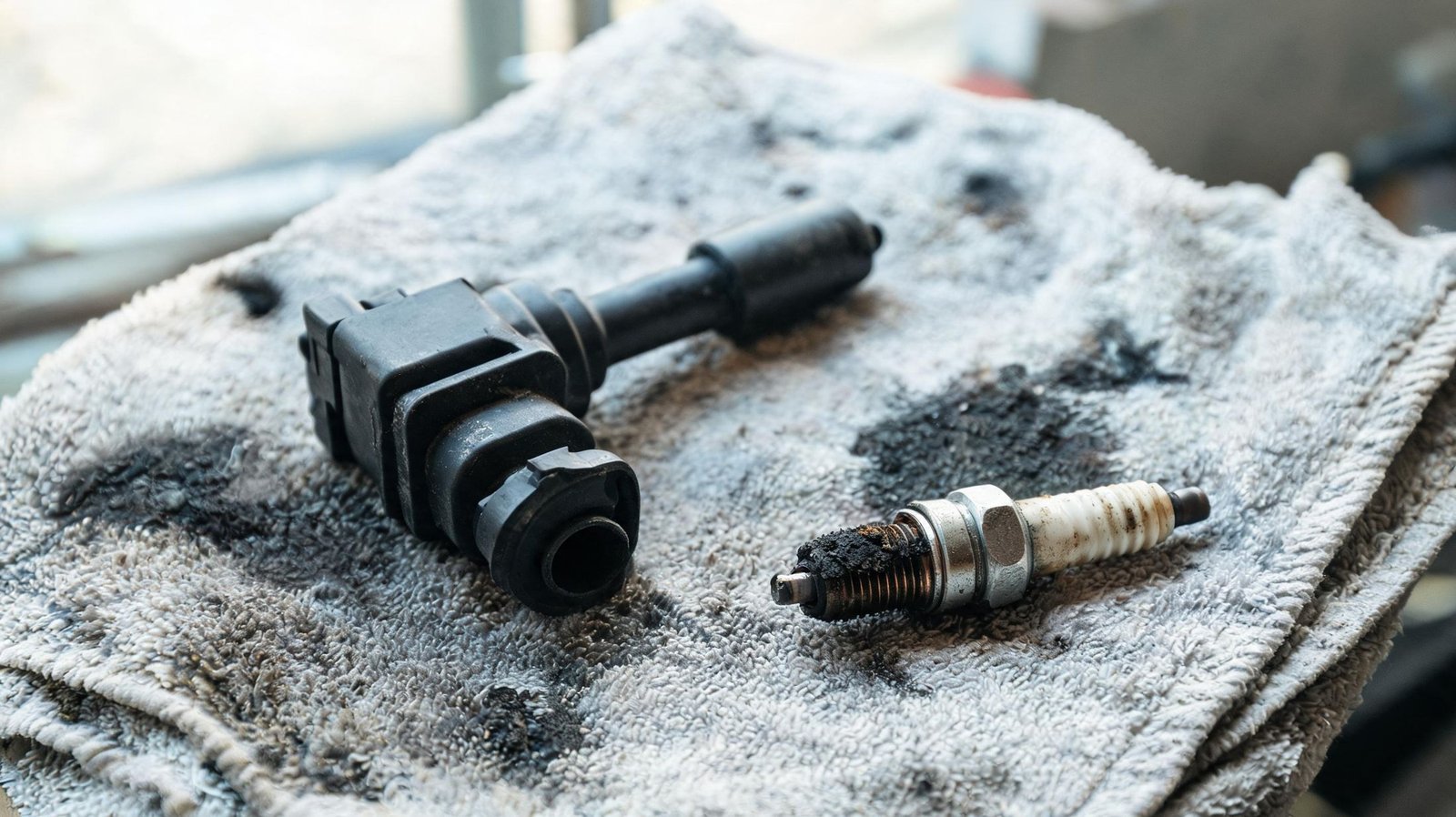
The P0301 code meaning is narrower than most drivers expect: the crankshaft-speed sensor detected that cylinder 1 is not accelerating the crank as fast as the others. It is a measurement of unequal power, not a diagnosis of a faulty component.
The computer watches the crankshaft speed after each firing event. Every cylinder gives the crank a small kick; a misfiring cylinder gives a weaker kick, and the ECU flags that cylinder by number. The final digit is the cylinder — P0301 is cylinder 1, P0302 is cylinder 2, and P0300 means the misfire is random rather than fixed to one cylinder.
What the code does not tell you is why. Ignition, fuel, air, compression and valve timing can all produce an identical P0301. That is why a parts-cannon approach — throwing coils and plugs at it — often costs more than a proper hour of diagnosis.
| Code | Meaning | What it usually points to |
|---|---|---|
| P0300 | Random / multiple cylinder misfire | Fuel pressure, vacuum leak, ignition system as a whole |
| P0301 | Cylinder 1 misfire | That cylinder's ignition, injector, compression or valve train |
| P0302 | Cylinder 2 misfire | As above, cylinder 2 |
| P0301 + P0302 | Adjacent cylinder misfires | Often a shared coil pack, head gasket breach or intake leak |
Does P0301 mean cylinder 1 is dead?
No. P0301 is a measurement, not a verdict — the ECU noticed that cylinder 1 is lagging the others at a set point in the firing order. Coil, plug, injector and wiring cause it long before compression does.
P0300 is a random or multiple-cylinder misfire, P0301 isolates cylinder 1, P0302 cylinder 2, and the series continues around the firing order. The freeze-frame data logged with the code — RPM, load, coolant temperature and fuel trims — is what separates an ignition fault from a fuel fault, and the swap test is what confirms it.
The code reads the same on every engine, but what sits on top of cylinder 1 changes the test order entirely. Compare the K20C-series in the Honda Civic with the Coyote 5.0 V8 in the Ford Mustang: coil-on-plug versus a very different ignition layout, same four-step diagnosis. If the cause does turn out to be mechanical, we supply a used Honda Civic engine for sale and a reconditioned Ford Mustang engine for sale.
- One family, several tunes: the K20C series includes the K20C1 (Civic Type R) and K20C4 (Accord) among others — the suffix identifies the application, and the parts do not always interchange.
What causes a P0301 misfire on cylinder 1?
In order of how often we see them: a failed ignition coil, a worn or fouled spark plug, a clogged or dead injector, a vacuum or intake leak near that cylinder, low compression from worn rings or valves, and — on some engines — a failed head gasket between two cylinders.
The list matters because the costs are wildly different. A coil on a four-cylinder is a fifty-dollar part. A compression fault is a replacement-engine conversation, and the two produce exactly the same fault code.
Cylinder position tells you something too. Cylinder 1 sits at the front on most inline engines, which is where a leaking injector seal or a split intake runner most often bites. On V-engine banks we look at which bank the code belongs to before deciding how far to strip the engine down.
- Ignition coil that has broken down under load
- Spark plug worn past its gap, cracked or oil-fouled
- Injector clogged, leaking or electrically dead
- Intake or vacuum leak feeding cylinder 1
- Low compression — worn rings, burned valve or valve-seat recession
- Head gasket breach between adjacent cylinders (often P0301 + P0302)
- Wiring or connector fault on the coil or injector circuit
How do I confirm the cause without guessing?
Run the swap test first: move the coil (and then the plug) to a different cylinder, clear the codes and re-read them. If the misfire moves with the part, replace the part. If it stays on cylinder 1, test fuel and compression before spending anything else.
This is the sequence we follow in the shop, and it costs almost nothing to repeat at home with basic tools. The swap test is decisive because it removes the part from the equation instead of guessing at its condition.
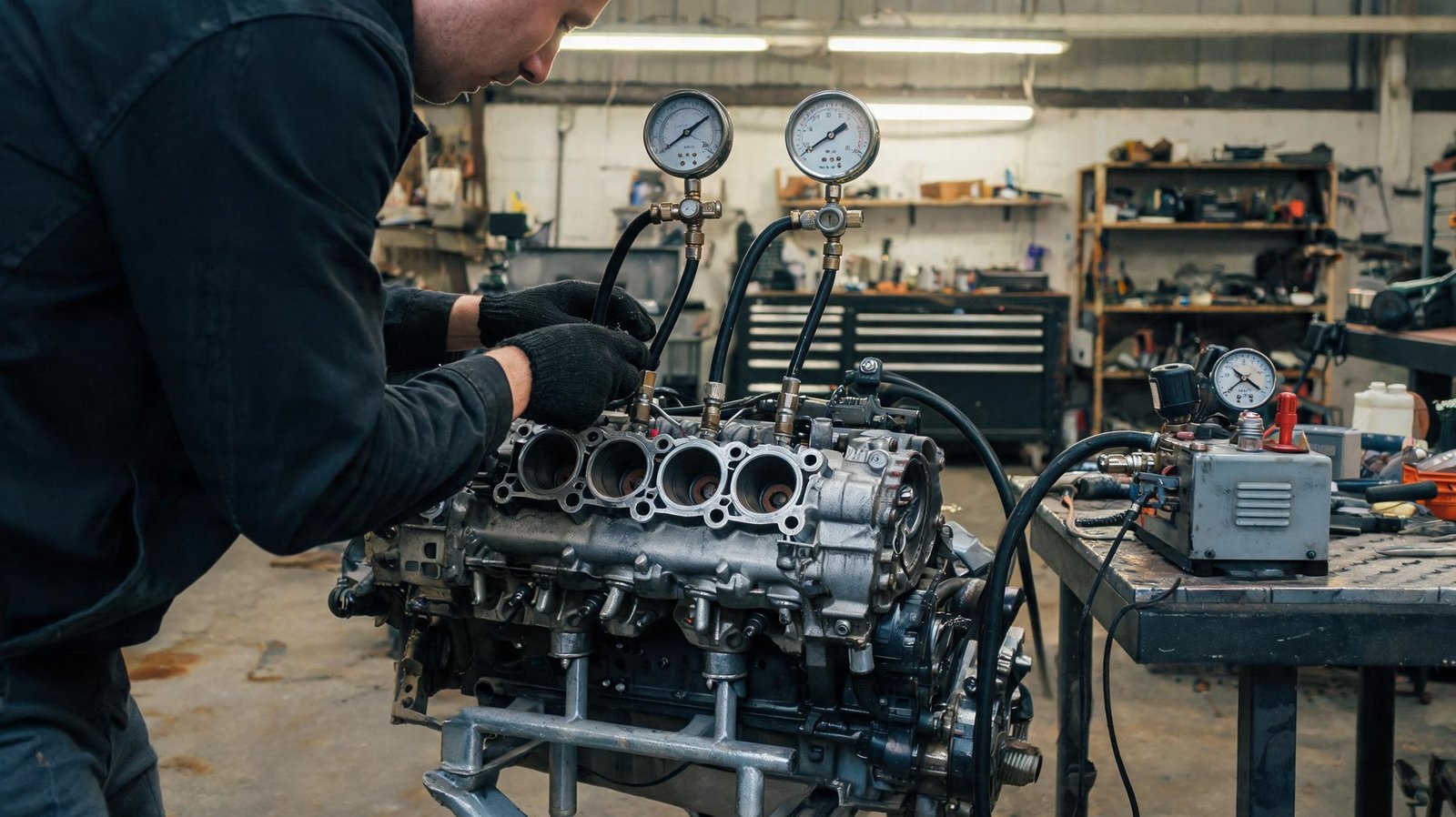
If the misfire stays put after the ignition has been cleared, the next test is fuel — injector pulse and flow — and then compression. A cylinder leakage test on a warm engine shows where the compression is escaping: past the rings (oil filler cap fizz), past the valves (intake or exhaust port), or between cylinders (bubbles in the coolant).
- Swap test — coil to another cylinder, clear codes, re-read. Misfire follows the coil? Replace it.
- Plug check — inspect colour and gap; a carbon-fouled plug tells you the cylinder is burning badly, not just sparking badly.
- Fuel test — confirm injector pulse with a noid light, then flow-test or swap the injector.
- Compression and leakage test — on a warm engine, compare cylinder-to-cylinder and find where the pressure is going.
- If leakage points to rings or valves, stop spending on ignition parts and price the engine work.
Can a P0301 be a worn engine rather than a bad coil?
Yes. When compression is low on cylinder 1 and the ignition and fuel systems are proven healthy, the misfire is mechanical — worn rings, a burned valve or a gasket breach — and no ignition part will fix it.
The giveaway is a misfire that returns within minutes of new parts going on, plus other symptoms: rising oil consumption, blue smoke from the exhaust, coolant loss with no visible leak, oil contamination, or a misfire that is worse when the engine is hot.
We are honest about this on the phone: if the evidence points mechanical, we say so before you order. That is also why our quotes start from the engine code — the misfire does not tell us which code your vehicle takes, and the code decides which unit physically fits. And if you are fuzzy on the difference between the build sticker, the VIN and the code itself, our engine code vs VIN guide lays all three side by side in one table.
If it does come to replacement, the same fault patterns show up across platforms. On high-mileage work trucks we supply a used Ford F-150 engine for sale and a reconditioned Ford F-150 engine for sale with the code verified against the VIN, and the same check applies to a B48 on the European side before anyone looks for a B48 for sale listing.
| Test result | Conclusion | Next step |
|---|---|---|
| Misfire follows the coil | Ignition fault | Replace the coil (and plug) |
| Misfire follows the injector | Fuel fault | Clean, replace or re-seal the injector |
| Compression even, leakage at intake/exhaust | Valve or seat fault | Head work — compare against a replacement unit |
| Compression low, leakage past the rings | Bottom-end wear | Replacement engine is the economical path |
| Bubbles at the coolant with misfire | Head gasket breach | Head job, or replacement if the deck is warped |
What does a P0301 cost to fix?
An ignition or fuel repair on cylinder 1 typically costs $60–$450, including the part and an hour of diagnosis. A compression or valve fault moves the bill into engine territory — the repair only makes sense if the rest of the engine is healthy.
The spread here is the whole point of this guide. Diagnosis is cheap; a coil is cheap; a rebuild is not. Spending one hour to prove which category you are in is the best money in the whole job.
Where the fault is mechanical, a tested replacement engine frequently costs less than a rebuild of a high-mileage bottom end — and it arrives with a warranty measured in months and miles rather than in promises.
| Outcome | Typical cost | Notes |
|---|---|---|
| Coil and plug on one cylinder | $60 – $250 | Most common result |
| Injector clean or replacement | $180 – $450 | Includes reseal kit where applicable |
| Diagnostic hour (compression + leakage) | $120 – $220 | The test that decides everything |
| Valve or head repair | $1,200 – $3,000 + labour | Only sensible on a healthy bottom end |
| Tested replacement engine | $900 – $3,500 + labour | Where compression proves the engine is worn |
Which units do we supply when the misfire turns out to be mechanical?
We supply used and reconditioned engines and transmissions, matched to your engine code and verified against your VIN before dispatch, with free insured freight anywhere in the USA in 12–16 working days.
If the diagnosis lands on replacement, the quiet reality is that the same model year can take more than one engine code, so the code matters more than the badge. That is why the quote starts there.
We also cover the drivetrain side, because a misfire that has been driven for months often takes the transmission with it through contaminated fluid and hard shifts: we supply a used Ford F-150 transmission for sale and a reconditioned Ford F-150 transmission for sale on the same fitment check, and on the GM side a 4L60E transmission for sale is one of the most requested units we ship.
- Used engines — 9 months / 6,000 miles, whichever comes first, whichever comes first
- Reconditioned engines — 16 months / 12,000 miles, whichever comes first
- Remanufactured engines — 36 months / 36,000 miles, whichever comes first
- Used and reconditioned transmissions, matched by code
- Compression-tested, and run-tested where the unit allows
How do I check fitment before ordering?
Enter your VIN or engine code in the fitment lookup on the quote page — the same check our desk runs by hand — and you will see nine options: three condition tiers across three warranty lengths.
The lookup exists for exactly this moment, when a misfire has just been proven mechanical and you need a unit rather than a lecture. Code in, fitment confirmed, then pricing.
If the code on your engine is hard to read, decode the VIN first with the NHTSA VIN decoder and bring both numbers to the call. And if you have not found the code yet at all, our engine code finder guide walks every location — block pad, sticker and VIN — in five minutes.
- VIN or engine code in → matched unit out, before any price is shown
- Nine options = 3 condition tiers × 3 warranty lengths
- Free insured freight, 12–16 working days, USA-wide
- A specialist confirms ambiguous platforms before dispatch
What do these terms mean?
Plain-English definitions of the technical terms used in this guide, so you can follow the diagnosis without a workshop dictionary.
Fuel Injector — A fuel injector meters fuel into the cylinder; when it clogs, leaks or fails electrically, that cylinder misfires exactly like an ignition fault.
Coil Swap Test — The coil swap test moves the ignition coil to another cylinder, clears the code and re-reads it — if the misfire follows the coil, the coil is the fault.
Where do these figures come from, and where can I verify them?
The price ranges, test procedures and thresholds in this guide follow standard trade practice and the public technical resources below. You can verify the background yourself:
Ranges are typical US independent-workshop figures and our own condition and warranty tiers — treat them as guidance, not a quote for your vehicle. A2Z Engines is the trading brand of QB AUTOZ LLC, a Mississippi-registered supplier — the company record is on our about page.
- ALLDATA repair database — misfire diagnostic trees and OEM test procedures by model.
- FuelEconomy.gov — how a misfiring engine shows up in official fuel-economy data.
- EPA vehicle and fuel emissions testing — why an unresolved misfire can fail an emissions test.
Which related guides should I read next?
These are the guides we hand to customers at the end of this conversation — each one picks up a thread from this post and finishes it.
- White Smoke and Coolant Loss: Is It a Head Gasket? — when the misfire is a head-gasket story.
- Why Is My Engine Knocking When Accelerating? — mechanical noise in the same cylinder, told apart.
- Rod Knock or Lifter Tick: How Do I Tell? — top-end and bottom-end noises, sorted in twenty minutes.
- Explore the site: shop by make · engine code index · used engines · transmissions — every unit fitment-checked before dispatch.
- Ready for numbers? Get your price — nine options across three condition tiers — or search the full catalogue; more guides live on the blog index.
Frequently asked questions
Does P0301 mean I need a new engine?
No. Most P0301 codes are ignition or fuel faults — a coil, plug or injector. Only a compression or leakage test proves the fault is mechanical.
Can I drive with a P0301 code?
With a steady light, drive gently and get it diagnosed promptly. With a flashing light, keep the revs low and get it looked at the same day; raw fuel is destroying the catalytic converter.
Why does my P0301 come back after new coils and plugs?
Because the cause is not ignition. If the misfire returns immediately on the same cylinder, move to fuel and compression testing rather than replacing more ignition parts.
What is the difference between P0300 and P0301?
P0300 is a random or multiple-cylinder misfire; P0301 is fixed to cylinder 1. A fixed code points at that cylinder's ignition, fuel or compression.
How much does a P0301 repair cost?
Typically $60–$450 for an ignition or fuel fix, including diagnosis. Mechanical causes move into engine territory — a tested replacement engine usually runs $900–$3,500 plus labour.
Which engine code do I need if replacement is required?
The one fitted to your vehicle, confirmed against the VIN range — the engine code index shows where to find it, and our quote is built from that code.
Do you supply transmissions as well?
Yes — used and reconditioned transmissions ship on the same fitment check, including common units such as a 4L60E transmission for sale.
What does this code actually mean?
The code tells you which cylinder is under-performing and how the ECU measured it — it does not name the faulty part. Coil, plug, injector, wiring and compression all produce the same code, which is why the swap test and a compression check come before any parts.
What should I know about cylinder 1 misfire causes?
Cylinder 1 misfires come from that cylinder’s coil, plug, injector or wiring first, and only later from low compression or a head gasket breach.
What should I know about misfire flashing check engine light?
A flashing check-engine light means raw fuel is reaching the catalytic converter and burning there — treat it as urgent, because the converter can be destroyed in a short drive.
What should I know about coil pack swap test?
On engines with shared coil packs, swapping the pack to another cylinder pair and re-reading the misfire code isolates the fault the same way as a single-coil swap.
Check your fitment and see nine price options
Enter your VIN or engine code — we match the unit to your vehicle before any price is shown. Nine options means three condition tiers across three warranty lengths.
Get my price Call +1 (662) 452-4928