
Rod Knock or Lifter Tick: How Do I Tell?
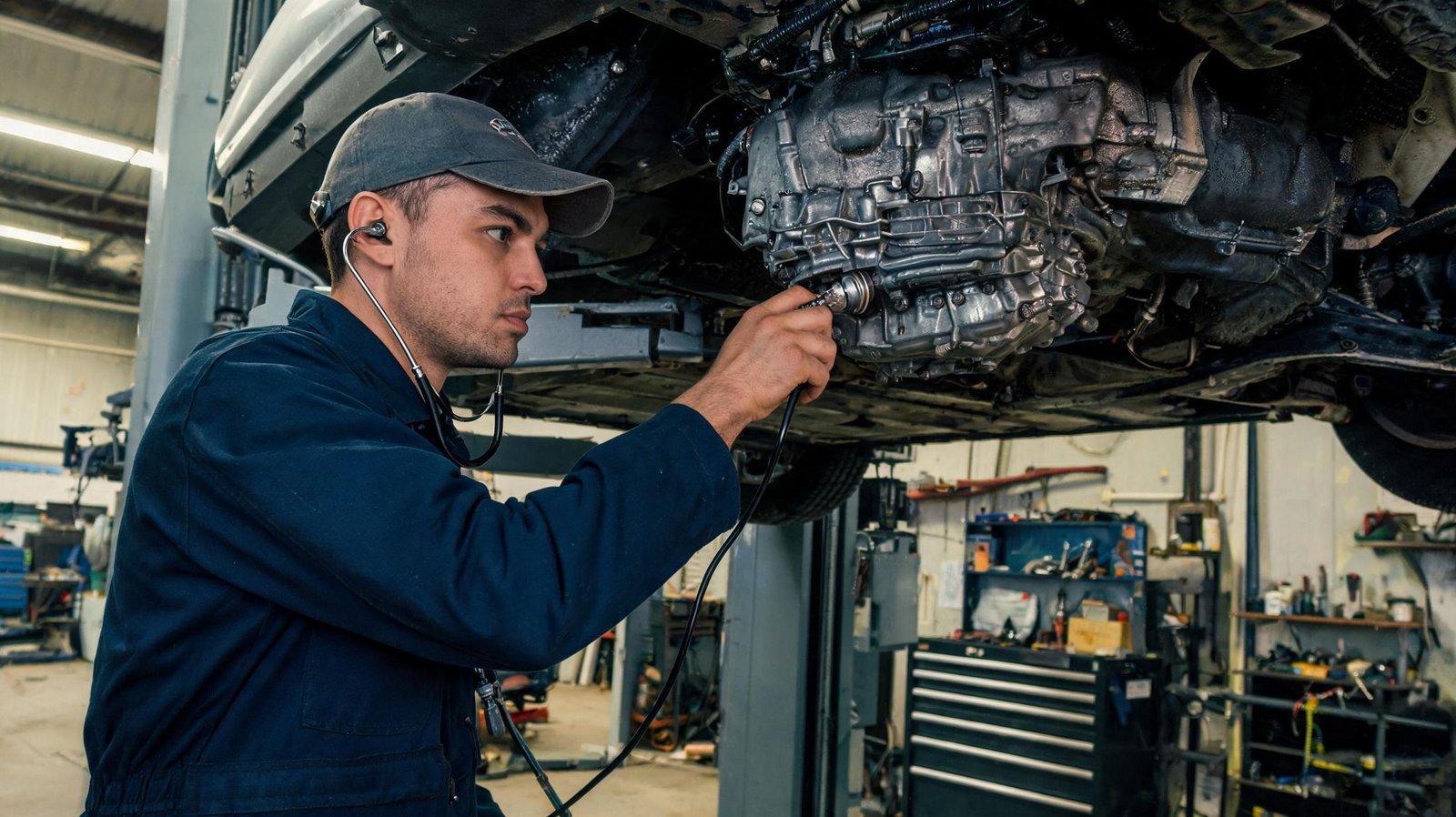
Top summary answer
Rod knock is a deep, hollow thud from the bottom end that worsens as the oil warms and sharpens under load — a bearing-wear emergency. Lifter tick is a light, fast click from the top end, often loudest at cold start — usually an oil or valvetrain service item, and occasionally an exhaust leak in costume. The stethoscope, the throttle blip and the dipstick separate them in twenty minutes.
Is my engine knocking or ticking — what's the difference?
Rod knock is a deep, hollow thud from the bottom of the engine — a hammer on a wooden block — that usually sharpens with load and worsens as the oil warms. Lifter tick is a much lighter, faster click from the top end that is often loudest on a cold start and can fade as oil pressure builds. One is a wear emergency; the other is frequently a service item.
The two sounds get confused because engines are loud and noise travels: a knock from the bottom end rings through the whole block, and a tick from under the valve cover can seem to come from everywhere at once. The way to separate them is not to strain your ears harder — it is to change the conditions and listen for what changes. Cold versus warm, idle versus load, top versus bottom.
We take these calls all day at the desk, and the stakes could not be more different. Bottom-end knock means bearing wear, and bearing wear means the engine is on borrowed time — the unit you are hearing is the unit you will be pricing. A top-end tick is often settled with the right oil and a service, which is why every guide on this site runs cheapest checks first. If your knock only shows up under acceleration, start with our knocking under acceleration guide — it covers that pattern in depth.
- Deep, hollow knock from low in the engine → think rod bearings, act now
- Light, fast tick from the top end → think lifters or an exhaust leak, diagnose this week
- Either noise plus a flickering oil-pressure light → switch off and recover the vehicle
- A tick that appears only after a long idle on a direct-injection engine → learn it, then stop worrying
Who is this knock-or-tick guide for?
This guide is for anyone standing over an engine deciding whether that noise is a small fix or a replacement unit: owners hearing something new, technicians writing the first diagnosis, and buyers judging a used car or used engine where the seller says 'they all sound like that'.
The use case is specific: there is a noise, it is new, and nobody agrees on what it is. Treat it as a top-end tick and a month later the engine is scrap; treat it as rod knock and you talk yourself into an engine you did not need. Both mistakes are common — we see the second every week, engines replaced for an exhaust gasket that ticks.
The decision context is one question: is this noise a service item or a countdown? The tell-apart table, the action table and the cost table below are written so you can answer it in one session with a stethoscope, a dipstick and twenty minutes — before anyone books labour or orders parts.
If you are an owner, work through the guide in order and stop wherever the job stops being DIY. If you run a shop, treat the recording questions and the cut-cylinder step as your intake checklist — they are the same ones our fitment desk uses when a customer sends a sound file and a mileage.
- Owners hearing a new knock or tick — before agreeing to any repair
- Technicians and apprentices writing the first diagnosis
- Buyers judging a used car or used engine
- Shop owners protecting a comeback record
What does rod knock actually sound like?
A deep, dull thud — imagine tapping a hammer on a wooden block — that repeats rhythmically from the lower half of the engine. It is mild when the oil is cold and thick, and it sharpens as the engine warms and the oil thins; with a throttle blip it usually answers immediately.
Place matters: the loudest point is low on the block, around the oil pan and the lower bellhousing — not under the valve cover. With a stethoscope, a long screwdriver or even a length of garden hose, the bottom end reads noticeably stronger. On the road it often shows up first at a steady 2,000–3,000 rpm cruise, and gets angrier under real load.
The pattern that makes us stop and listen properly is the combination: knock plus an oil-pressure warning light flickering at idle. That pairing means the clearance problem is already big, and the next mile can turn a worn bearing into a spun one. In our experience that is the moment to park it — a rebuilt bottom end on a high-mileage engine rarely makes financial sense against a tested replacement.
And the tired myth worth ignoring: you do not diagnose this by counting beats. Rhythm alone misleads, because both ends of the engine move at half crank speed. Location, load response and oil pressure are the honest witnesses.
What does lifter tick actually sound like?
A light, fast, regular click from the top of the engine — a sewing machine needle rather than a hammer — usually loudest in the first seconds after a cold start, and sometimes quieter once oil pressure builds. It tends to keep a steady rhythm regardless of load.
Lifters are pumped by oil pressure, and overnight drain-back is why the noise is a cold-start guest. On hydraulic-lifter engines the classic pattern is a tick for the first ten to thirty seconds that fades as the galleries refill — check the oil level and grade first, because low or wrong-spec oil makes every lifter in the engine complain. The search term people use is engine ticking noise; the workshop term is lifter tick — it is the same conversation, and the checks below apply either way.
A tick that stays all day, hot and cold, has more to say: it can be a worn lifter face, a scored cam lobe, or an exhaust manifold gasket leaking at the flange — that last one mimics a top-end tick so well that many engines get condemned for it. On direct-injection engines there is also a normal, purposeful tick from the high-pressure fuel pump that has never hurt anything except its owner's nerves.
A probe sorts these in minutes: valve cover first, then the exhaust flanges, then the high-pressure pump. Wherever the click reads loudest is where the diagnosis starts — and if a fresh oil service quiets the noise entirely, the engine just told you what it needed.
How do I tell rod knock and lifter tick apart at the car?
Run the same checks in order — when it appears, where it is loudest, how it answers the throttle blip, what the oil level and condition say, and what the oil-pressure light does. The tell-apart table below maps every answer to its likely cause.
One session, one vehicle, twenty minutes: note the conditions, then the location, then the reactions. Do not skip the boring steps — the dipstick and the service history settle more cases than the stethoscope does. And write the answers down; a recorded sample beside written conditions is exactly what a fitment desk needs to help you properly.
- Note when it appears — cold start, warm idle, or only under load. Timing eliminates half the causes before you open the hood.
- Probe for the loudest point — valve cover versus oil pan and block sides. Top end or bottom end, the probe decides.
- Run the throttle blip — rev to about 2,500 rpm and release. Rod knock usually sharpens; lifter tick stays steady or fades.
- Read the dipstick — level, color, glitter. Low or old oil amplifies both noises, and metallic sparkle in the oil is a stop-driving finding.
- Watch the oil-pressure light or gauge at idle — a flicker with a knock turns the rest of the checklist into a recovery plan.
- Record it — thirty seconds over the oil pan, thirty over the valve cover. A phone video of each is the best money you never spent.
| Feature | Rod knock | Lifter tick |
|---|---|---|
| Sound | Deep, hollow thud — a hammer on wood | Light, high click — a sewing-machine needle |
| Loudest where | Lower engine, near the oil pan | Top end, under the valve cover |
| When it shows | Usually warm, after a run or at idle | Often cold start; may fade as pressure builds |
| Load response | Sharper under load and on the blip | Fairly steady; often fades with revs |
| Oil pressure | May flicker the warning light at idle | Normally unaffected |
| Driving advice | Stop and diagnose — damage accelerates fast | Short-term driving with oil checked, diagnose soon |
| Typical repair | Rebuilt bottom end or tested replacement | Oil service, lifter set, cam work, or an exhaust gasket |
What causes rod knock?
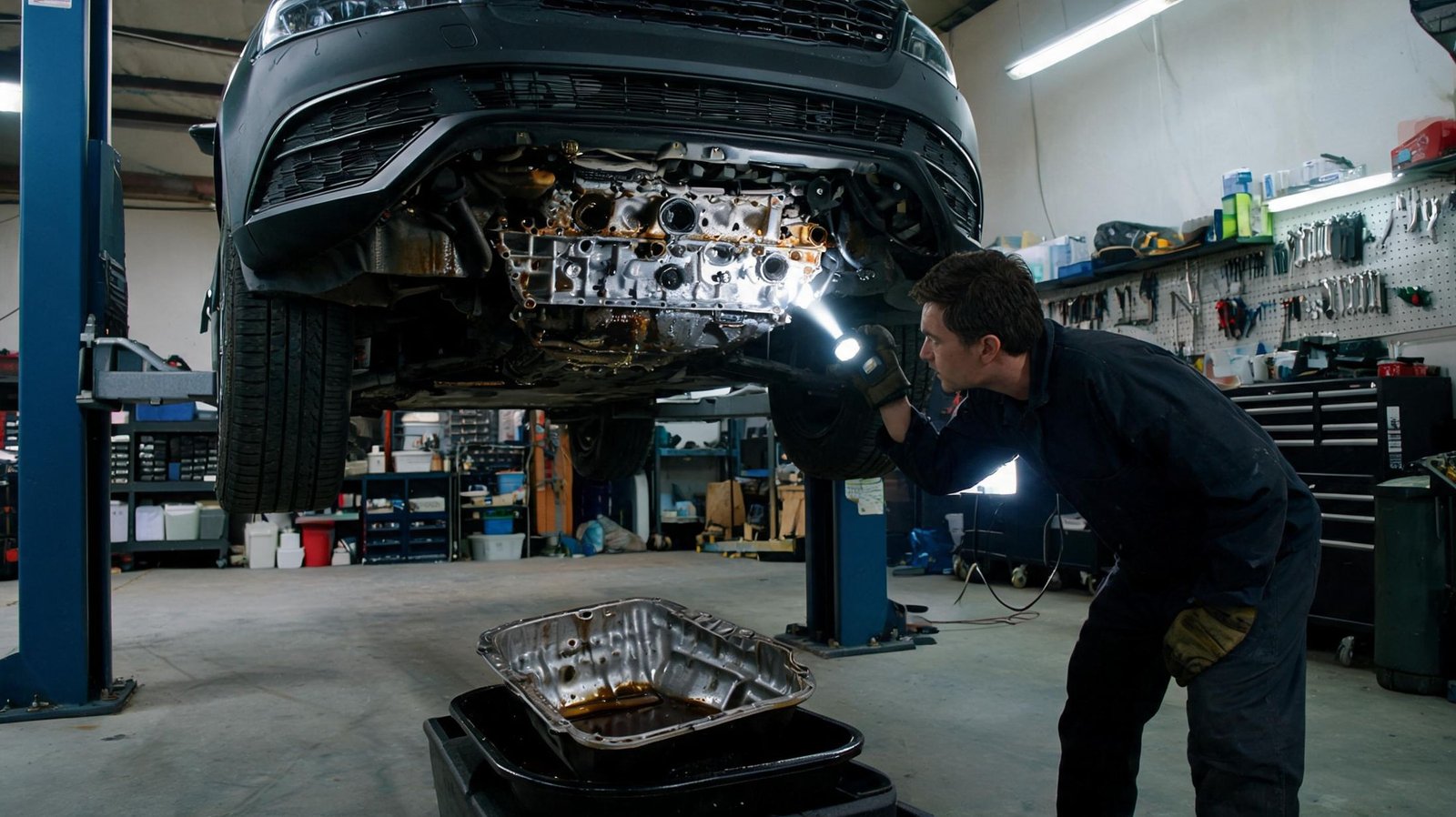
Bearing wear — plain and simple. Rod bearings wear when the oil film fails: starvation from a low level, oil that stopped doing its job, heat, mileage or contamination. By the time the knock is audible, the clearance is already out of spec and the damage only accelerates.
The chain is boring and predictable: oil level drops or oil quality fades, the film thins, metal touches metal, and the bearing shell loses its surface. Sometimes a single oil-starvation event — a hard corner taken low on oil, a missed service, a failed pressure sender nobody noticed — starts it in an afternoon. Sometimes it is simply a hundred and ninety thousand miles. Either way, the result sounds the same.
Chronic oil consumption is the chapter before the noise. An engine that has been drinking a quart every eight hundred miles for a year has been running on reduced margin the whole time; when the film finally gives, the knock arrives with no warning beyond the dipstick. That entire story — measurement, thresholds, causes — is covered in how much oil consumption is normal.
What you do about it depends on how early you caught it. Bearing material glittering in drained oil with a fresh knock is a shop-first, drive-second situation; a low-mileage engine caught early is a rebuild decision; and a high-mileage engine with confirmed bearing damage practically prices itself against a tested replacement — which is the math the cost table below lays out.
What causes lifter tick?
Mostly oil: a low level, the wrong viscosity or specification, or galleries that have taken on varnish and sludge. Behind that come a collapsed or worn lifter, a scored cam lobe, and the great imitators — an exhaust manifold gasket or a normal direct-injection pump tick.
Start with the cheapest explanation. Most hydraulic lifter noise is an oil story: too little, too old, or the wrong specification for the engine. Hydraulic lifters are oil-pressure devices; give them fresh, correct oil at the right level and a meaningful share of ticks simply stop. The specification matters as much as the amount — a bottle that does not carry the manufacturer's approval can leave lifters slow to pump up, especially on turbocharged engines where the spec also protects against low-speed pre-ignition.
If fresh oil and a filter do not quiet it, the next suspects are mechanical: a lifter bleeding down overnight, a cam lobe losing its edge, or oil galleries restricted by years of sludge. A flush can help a neglected engine — and occasionally unmasks a tick that sludge was cushioning — while a worn lobe will only ever get louder.
Then there are the actors playing lifter. An exhaust manifold gasket cracked at a flange ticks in perfect rhythm and sends people shopping for valvetrain parts; a high-pressure fuel pump on a direct-injection engine ticks by design. Before any parts are ordered, our rule is simple: find the loudest point with a probe, confirm it twice, and only then talk about parts.
Can I drive with a knock or a tick — when is it urgent?
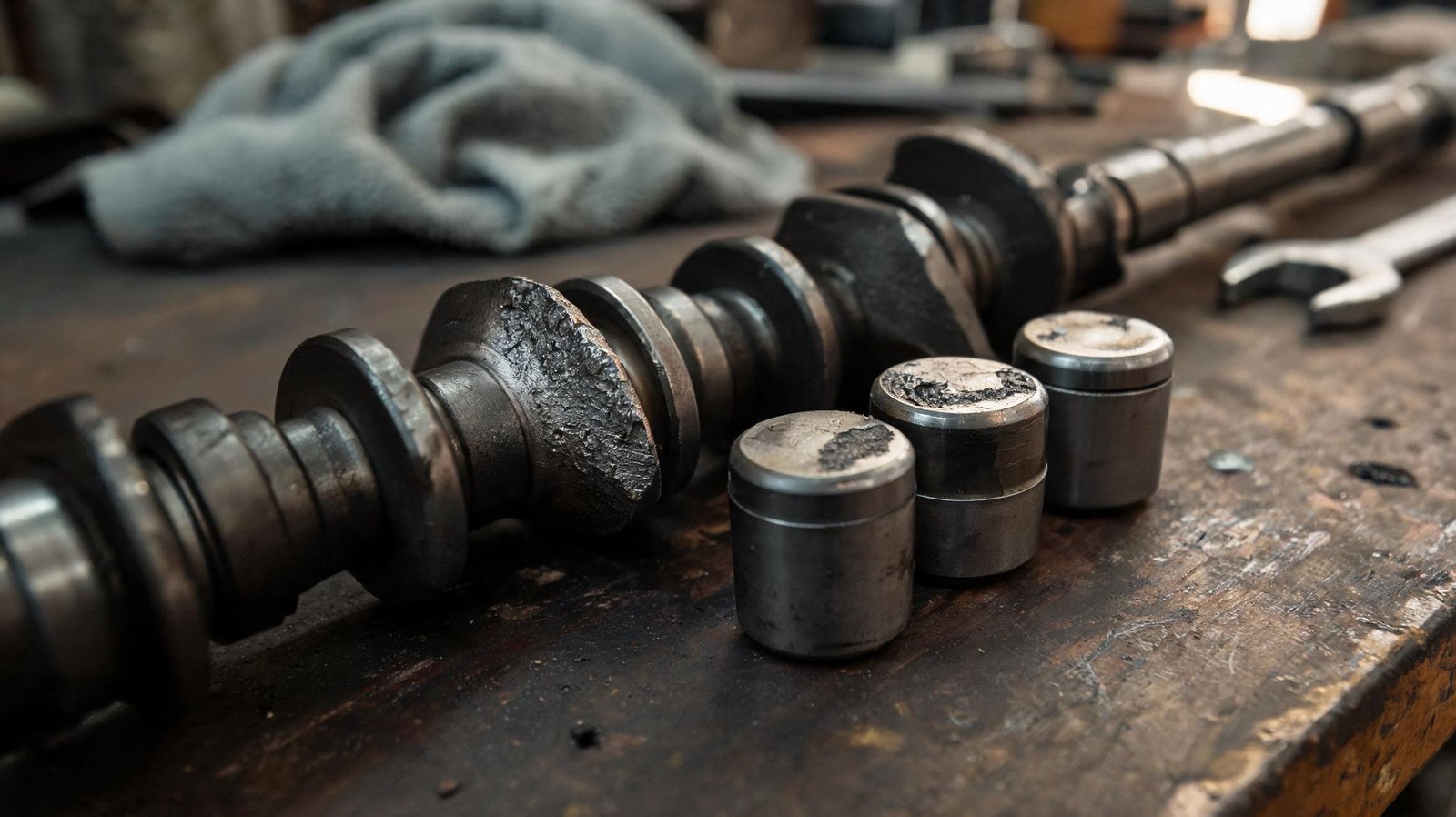
A light lifter tick with correct oil and normal oil pressure is usually fine to drive short-term while you book a diagnosis. A deep knock is not: bearing damage accelerates every mile, and a knock combined with an oil-pressure light means switch off and recover the vehicle.
This is the decision the whole guide builds toward, and it turns on evidence rather than nerves: oil pressure, oil condition, and where the sound lives. If the pressure light behaves and the tick is top-end, you have room to schedule. If the knock is bottom-end, that room is measured in miles, not weeks.
When in doubt, the conservative reading costs a recovery fee; the optimistic one can cost a block, a crankshaft and a core deposit. We tell customers plainly: we would rather sell you an engine next year than have this month's phone call open with 'it let go on the highway'.
| What you hear | Most likely | Urgency | What to do |
|---|---|---|---|
| Cold-start tick that fades in seconds | Hydraulic lifters refilling | Low | Check oil level and grade; monitor |
| Steady tick, hot and cold | Lifter, cam lobe or exhaust leak | Medium | Book diagnosis; keep driving gently |
| Deep knock on the throttle blip | Bottom-end bearing wear | High | Stop driving; recover to a shop |
| Knock plus oil-pressure light | Oil starvation, bearing damage | Emergency | Switch off as soon as it is safe; recover the vehicle |
| Tick only after a long idle | Normal on direct-injection engines | Low | Learn the sound so it stops worrying you |
| Metallic glitter in the oil | Bearing material | High | No more driving; full inspection |
What does diagnosis and repair cost — and when is replacement the better buy?
Diagnosis runs $80–$200 and is the best-value line in any of these quotes. Lifter and cam work lands between $800 and $2,500; a rod-bearing repair runs $2,000–$4,500 and rarely makes sense on a high-mileage engine, where a tested replacement typically starts around $900 plus labour.
The economics are blunt: repairing a bottom end means crankshaft work, bearings and gaskets on an engine that has already used up its first life. On a high-mileage unit the repair bill usually crosses half the price of a tested replacement — and the replacement arrives with recorded tests and a real warranty behind it.
That is why our desk asks for the diagnosis, not just the symptom: an hour of stethoscope time can move a customer from a $3,000 engine conversation into a $150 oil service — and when the bottom end really is gone, the three condition tiers let the budget decide the cover: used, reconditioned or remanufactured, each with a longer warranty than the last — 9, 16 or 36 months, whichever comes first.
| Job | Typical cost | What it covers |
|---|---|---|
| Diagnostic session | $80–$200 | Probe mapping, oil-pressure check, road test |
| Oil and filter change | $70–$150 | Correct specification and fresh filter — the first lifter-tick test |
| Engine flush | $120–$250 | Clears varnish and sludge from oil galleries |
| Lifter and cam service | $800–$2,500 | Lifter set, cam inspection or replacement, labour |
| Rod bearing repair | $2,000–$4,500 | Crank out, bearings, machining — rarely economic on high-mileage units |
| Used engine, fitted | $900–$2,200 plus labour | Tested take-out matched to your engine code |
| Reconditioned engine, fitted | $1,500–$3,000 plus labour | Worn service parts replaced and re-tested |
| Remanufactured engine, fitted | $2,300–$3,500 plus labour | Rebuilt to specification, longest cover |
What do we supply when the diagnosis is bottom-end damage?
Used, reconditioned and remanufactured engines, matched to your engine code and VIN-checked before dispatch, with free insured freight USA-wide in 12–16 working days — plus the transmission when the wear took it along.
The platform decides the unit: we supply a used Ford F-150 engine for sale and a reconditioned Ford F-150 engine for sale for the truck side, and full-size fitment like the Chevrolet Silverado 1500 runs through the same VIN check. Every unit leaves the bench compression-tested — and run-tested where the unit allows.
Transmissions travel with the same problem: an engine that has been knocking rarely treated its gearbox kindly. We supply a used Ford F-150 transmission for sale and a reconditioned Ford F-150 transmission for sale on the same fitment discipline, alongside the rest of the transmission range.
- Compression-tested on the bench — run-tested where the unit allows
- 9/16/36 months warranty, whichever comes first — by condition tier
- VIN cross-matched before dispatch — nothing ships until fitment matches
- Free insured freight, USA-wide, 12–16 working days
- Fitment desk, Mon–Sat 8AM–6PM — answers before you order, not after
What does A2Z Engines check when a knock-or-tick call comes in?
The same ladder every time: how it sounds, when it appears, what the oil pressure does — and where it reads loudest on a probe. Only when the story points below does the conversation turn to units; the top-end stories get sent back for an oil service first.
Calls arrive as voice notes and driveway videos, and honestly, that is ideal — we ask for thirty seconds over the oil pan and thirty over the valve cover, plus the odometer reading. Between the two recordings and the pressure behavior, the desk can usually place a call on the right rung of the ladder before a single part is mentioned.
The textbook case from last month: a customer sent a clip captioned 'rod knock, need a price' from a 5.3 truck that ticked like a sewing machine at every cold start and disappeared warm — an exhaust gasket leak at the flange, confirmed at his local shop for a fraction of the quote he had braced for. The other side of the counter exists too: a genuine bottom-end knock with a flickering pressure light and glitter in the oil sample — that call went straight to a tested unit with a warranty-backed supply and the claim file explained up front.
Either way the file matters: the recordings, the mileage, the oil-service history, and the confirmation a shop writes down. It is the same paperwork our claims team asks for, and it is why we keep repeating the same sentence — listen first, price second.
- When did it start, and under what conditions — cold, warm, or under load?
- The two recordings — oil pan and valve cover — plus the odometer and last oil service
- Oil level, condition and pressure behavior; any glitter in a drained sample
- Where a probe reads loudest at the customer's shop, confirmed twice
- Verdict: oil service or top-end work, versus bottom-end confirmation and a fitment-checked unit
How do I confirm fitment before ordering?
Enter the VIN or the engine code on the quote page; you get nine options across three condition tiers and three warranty lengths, with the code confirmed against your VIN range before anything ships. Not sure where your code lives? Our engine code finder guide walks every location in five minutes.
If the code on the block is hard to read behind brackets and grime, decode the VIN with the NHTSA VIN decoder and use the engine code index to find where the stamping sits on your platform. The fitment check is the same one the desk runs — nine options, exact code, nothing shipped on a guess.
- VIN or engine code entry — get your price in minutes
- Nine options: three condition tiers across three warranty lengths
- VIN-range cross-match before dispatch — confirmed, not assumed
- A real person on the fitment desk if the stamping is unreadable
What do these terms mean?
Plain-English definitions of the technical terms in this guide, so you can follow the diagnosis without a workshop dictionary.
Rod Knock — Rod knock is the deep, hollow thud of a worn rod bearing letting the connecting rod strike the crankshaft journal with every revolution — the sound of a failed oil film, not a tuning problem.
Lifter Tick — Lifter tick is the light, fast click of a hydraulic lifter that has not pumped up fully, usually at cold start; it can also be a scored cam lobe or an exhaust leak wearing its costume.
Hydraulic Lifter — A hydraulic lifter (or lash adjuster) is a small oil-pressure piston in the valvetrain that takes up clearance automatically; when it bleeds down or clogs, the valvetrain announces it.
Cam Lobe — The cam lobe is the egg-shaped section of the camshaft that opens each valve; once its surface scores, the tick becomes permanent and the fix is cam work, not oil.
Spun Bearing — A spun bearing is a rod bearing that has rotated in its seat after seizing, cutting oil flow and destroying the journal — the moment a rebuild becomes a replacement.
Cut-Cylinder Test — A cut-cylinder test disables one cylinder at a time while a technician listens; a knock that changes or disappears points at the rod on that cylinder.
Direct-Injection Tick — Direct-injection tick is the normal, purposeful clicking of a high-pressure fuel pump on GDI engines — loud, healthy, and best learned once so it never worries you again.
Where do these figures come from, and where can I verify them?
The sound descriptions, checks and price ranges follow standard trade practice and the public technical resources below. You can verify the background yourself:
Ranges are typical US independent-workshop figures and our own condition and warranty tiers — treat them as guidance, not a quote for your vehicle. A2Z Engines is the trading brand of QB AUTOZ LLC, a Mississippi-registered supplier — the company record is on our about page.
- NHTSA VIN decoder — confirm your exact vehicle and engine variant before ordering parts or a unit
- API Engine Oil Matters — viscosity, specification, and why oil quality decides lifter behaviour
- EPA vehicle and fuel emissions testing — how mechanical faults surface in emissions testing
- FuelEconomy.gov — official fuel-economy data, and why mechanical drag shows up there
Which related guides should I read next?
These are the guides we hand to customers at the end of this conversation — each one picks up a thread from this post and finishes it.
- Why Is My Engine Knocking When Accelerating? — the load-related knock, in depth.
- How Much Oil Consumption Is Normal? — the wear story that comes first.
- What Does a P0301 Misfire Code Actually Prove? — the code that sometimes rides along.
- Explore the site: shop by make · engine code index · used engines · transmissions — every unit fitment-checked before dispatch.
- Ready for numbers? Get your price — nine options across three condition tiers — or search the full catalogue; more guides live on the blog index.
Frequently asked questions
Can I drive with rod knock?
No. Knock means bearing clearance has opened up, and every mile accelerates the damage — the worst case turns a worn bearing into a spun one. If the oil-pressure light flickers as well, switch off as soon as it is safe and have the vehicle recovered. Diagnosis first, driving never.
Can I drive with a lifter tick?
Usually yes, short-term — provided the oil level and specification are correct and the oil-pressure light behaves normally. Book a diagnosis and keep the trips gentle; if the tick gets louder, changes tone, or comes with any pressure warning, stop and treat it like a bottom-end symptom.
Does lifter tick go away after an oil change?
Often, yes — especially if the oil was old, low, or the wrong specification. Fresh oil at the right level lets hydraulic lifters pump up fully again and many ticks simply stop. If the noise survives a correct oil and filter service, the next suspects are a worn lifter, a scored cam lobe, or an exhaust leak at the manifold flange.
Is rod knock always the end of the engine?
For practical purposes on a high-mileage unit, yes — a proper bearing repair means crankshaft work, bearings and gaskets, and the bill usually crosses half the price of a tested replacement. On a low-mileage engine caught early, a rebuild can make sense. We supply whichever way you decide, and we will tell you honestly which side of that line your numbers fall on.
Does rod knock get quieter when the engine is warm?
Usually the opposite — it gets louder. Cold, thick oil cushions the worn clearance for a few minutes; as the engine warms and the oil thins, the bearing knock sharpens. A knock that is loudest on a cold start and fades within seconds is more often a lifter or piston-slap pattern than a rod bearing.
Can a ticking sound be something other than lifters?
Absolutely — and this is how good engines get condemned. A cracked exhaust manifold gasket ticks in perfect rhythm, a direct-injection high-pressure pump ticks by design, and worn timing components or lazy injectors can click too. A probe on the valve cover, the exhaust flanges and the pump separates the players in minutes.
Why does the tick come from the top of the engine?
The valvetrain is where oil pressure works hardest against gravity: lifters, lash adjusters and cam lobes sit at the top, and overnight drain-back is why the first seconds after a cold start are the noisiest. A top-end tick is a clue, not a verdict — the probe still has to confirm where it reads loudest.
How long can I drive with a tick?
With the oil correct and pressure normal, a light tick can be monitored for weeks while you book a diagnosis — but do book it. A worn lifter face or cam lobe only ever progresses, and the difference between service work and cam work is measured in how long the noise was ignored.
Will thicker oil fix lifter tick?
Start with the right specification first, not the thickest bottle on the shelf. The manufacturer's approval code exists because the wrong viscosity can raise consumption, upset variable valve timing and even worsen the tick. 'Noise-fixer' additives might mask it briefly; they do not repair a worn lifter or a scored lobe.
How does a shop confirm it is rod knock before parts are ordered?
Two checks carry the weight: a cut-cylinder test, where disabling one cylinder at a time changes the knock if the rod on that cylinder is at fault, and an oil sample for metallic glitter. Together with the oil-pressure reading and the probe location, that evidence is strong enough to commit to a repair or a replacement — and it is exactly the file our desk and our claims team want to see.
What warranty comes with a replacement engine?
Every tier carries cover: 9 months on used, 16 on reconditioned, 36 on remanufactured — 9/16/36 months, whichever comes first. Warranty starts at delivery, the claim process is a written 48-hour decision once the file is complete, and the full terms live on the warranty page with the claim steps on the claim policy.
Check your fitment and see nine price options
Enter your VIN or engine code — we match the unit to your vehicle before any price is shown. Nine options means three condition tiers across three warranty lengths.
Get my price Call +1 (662) 452-4928