What Is an Engine Code and Why Does It Decide Fitment?
Top summary answer
An engine code is the manufacturer's short identifier for one exact engine design and version — B48, EA888, L83 — stamped on the block and repeated on build stickers. It is the one piece of information that decides which replacement engines fit your car, what they cost, and what the warranty rides on. This guide explains what an engine code is, where it lives, and why fitment runs on it and nothing softer.
What is an engine code — in one sentence?
An engine code is the manufacturer's short name for one specific engine design and version — like B48, EA888, L83 or 2GR-FKS — stamped on the block and printed on build stickers. It tells a supplier exactly which engine your car needs, which is why it decides fitment, price and warranty.
The question — what is an engine code? — sounds like trivia until money is on the line. A listing says 'fits 2015–2020' and your car sits inside that range, so surely it fits? Not necessarily: a model year is a sales frame, and several engine codes can live inside one year range. The code is the engineering fact underneath the marketing sentence, and it is the only thing a serious fitment decision can stand on.
Mechanically, a code is a family name with a version suffix. A B48 and a B48B share architecture but can differ in the details that matter at install — sumps, mounts, emissions hardware. The same pattern repeats at every manufacturer from Audi's EA888 to Ford's 5.0 Coyote. That is why distributors index their catalogues by code, interchange lists are built from it, and prices move by it.
When the code is confirmed, everything downstream gets simple: the correct interchange list opens, the nine options get priced, and the unit ships with a label that matches your file. When the code is missing or wrong, 'will it fit?' has no honest answer — only a hope with freight attached.
- A short manufacturer identifier — letters, digits, often a version suffix
- Stamped on the block, repeated on stickers and build sheets
- Names one engine design and version — not one specific unit
- The ordering key for every replacement engine we supply
Who is this guide for?
Anyone whose decision depends on one engine fitting one car: owners facing a replacement quote, shops sourcing units, buyers checking a used car or a salvage listing, and DIY swappers confirming a purchase before the lift.
The use case is always a money moment. An owner gets a quote that says 'fits your car' and wants to know what that claim actually stands on. A shop wants to release a unit against something stronger than a sales promise. A buyer at a salvage yard is looking at a block with no paperwork and needs to know what question to ask first. Each of those moments runs better once the code is on the table.
The decision context is identical in every case: the code pins down the design, the VIN anchors the build, and the intersection is where a confident fitment decision lives. Swapped covers, marketplace listings and ambiguous year ranges all get caught by the same code-first check our desk runs on every order.
If you are an owner, this guide gives you ten minutes of vocabulary that can save four figures in return freight. If you run a shop, it is the intake checklist for engine orders — and the answer sheet for the customer who is sure that the model year settles everything.
- Owners before agreeing to a replacement quote
- Shops releasing units from a supplier
- Buyers checking a used car or a salvage engine
- DIY swappers verifying fitment before the lift goes up
What does an engine code actually name?
One engine design and its version — displacement, architecture (inline-4, V6, V8), induction (naturally aspirated or turbo), fuel system and emissions family. It does not name your specific unit, and it does not name your specific car — those are different identifiers entirely.
Think of the code as the engine's model name. Every B48 was built to the same design intent; every EA888 shares a family tree; every L83 is the same generation of GM's small-block family. Two cars built years apart, or in different plants, can carry engines that share a code because they share the design — that is exactly what makes the code useful for ordering.
The suffix is where care pays off. Manufacturers revise designs over a production run, and the suffix marks the revision — revised covers, relocated sensors, a different sump. Some revisions interchange cleanly; others do not. The stamped code, read character by character, is what tells the desk which revision a listing is actually offering.
One practical consequence: when a listing shows no engine code at all, the honest reading is that the seller does not know what they have. That is your cue to keep looking, or to send the listing to a desk that decodes and confirms for free before you commit.
Where do I find my engine code?
On the engine itself — the machined pad on the block — and on labels: a sticker on the engine cover or timing cover, and the build sticker often found in the glovebox (GM's RPO list, for example). The stamping on the block is the one that settles every argument.
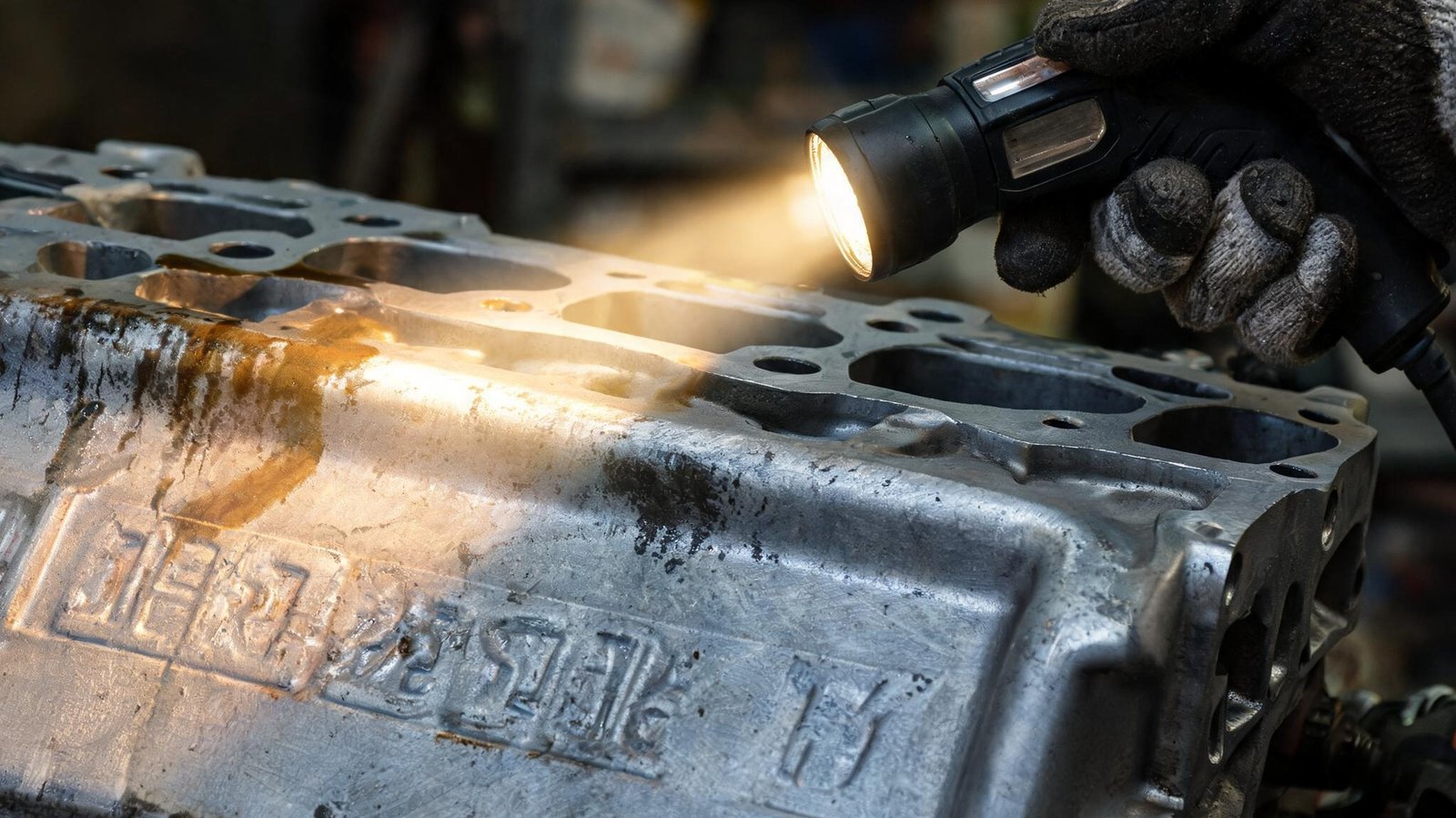
Start with the engine bay: a phone flashlight held at a low angle makes faint stampings readable, because the light rakes across the characters instead of washing them out. If the pad is buried, the sticker route usually gets you there — then the pad confirms it. We walk through the full routine in our guide to finding your engine code, make by make — a practical engine code lookup you can finish in five minutes.
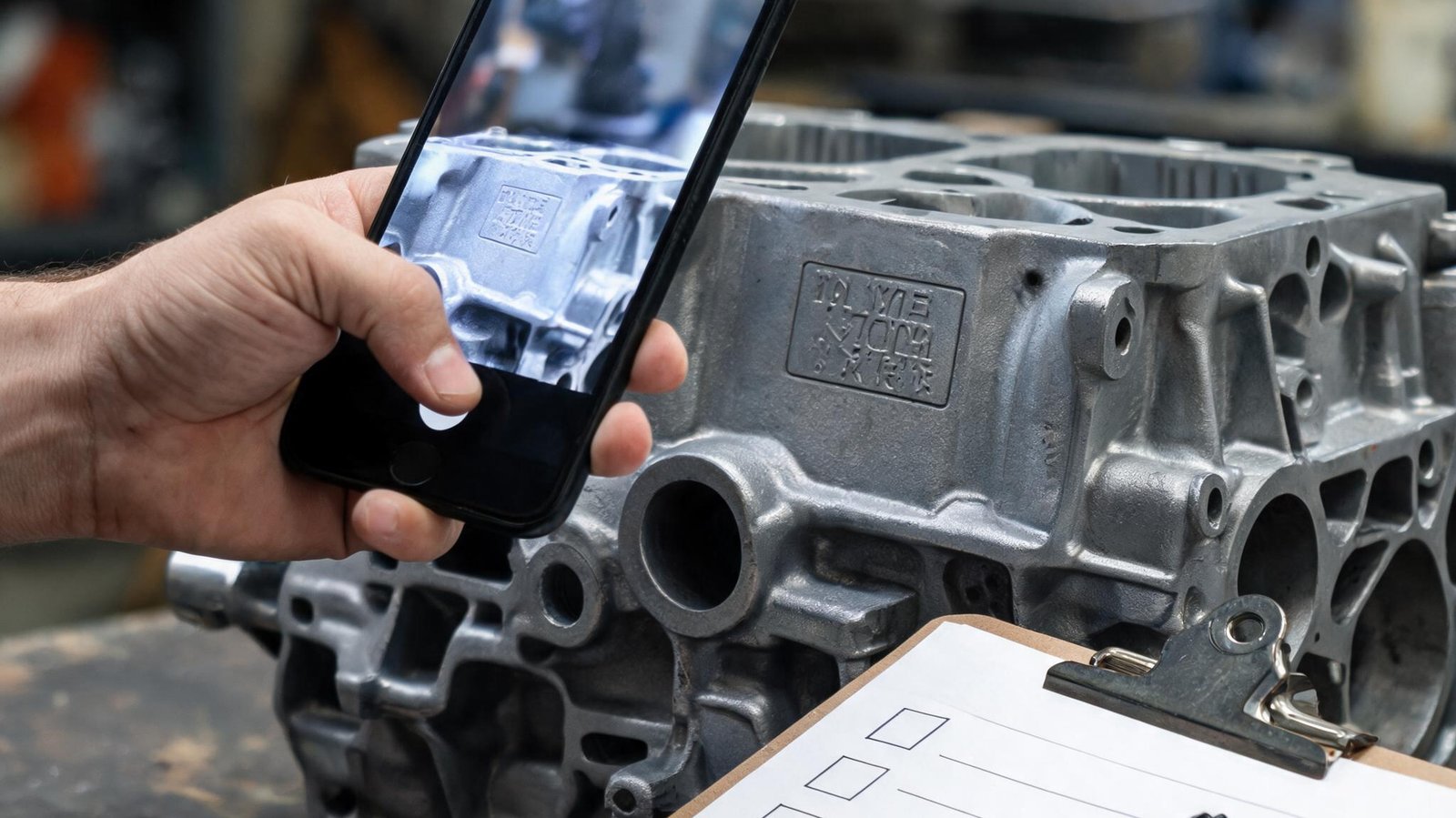
Photograph two things while you are in there: a close-up of the characters and a wider shot showing where that pad sits on the engine. The wide shot is what lets the desk confirm the pad you photographed is the pad that matters — especially when covers, brackets or grime make the view ambiguous.
- Machined pad on the cylinder block — the authoritative stamping
- Engine cover or timing cover sticker — fast, occasionally replaced
- Glovebox build sticker — good for cross-checks, not for stampings
- Two photos: close-up of the code, wide shot of its location
Why does the engine code decide fitment?
Because engines of the same displacement can differ in everything that bolts them into your car — mounts, sump shape, sensors, emissions hardware and calibration. The code is the lookup key that tells the fitment desk which of those details apply to your exact vehicle.
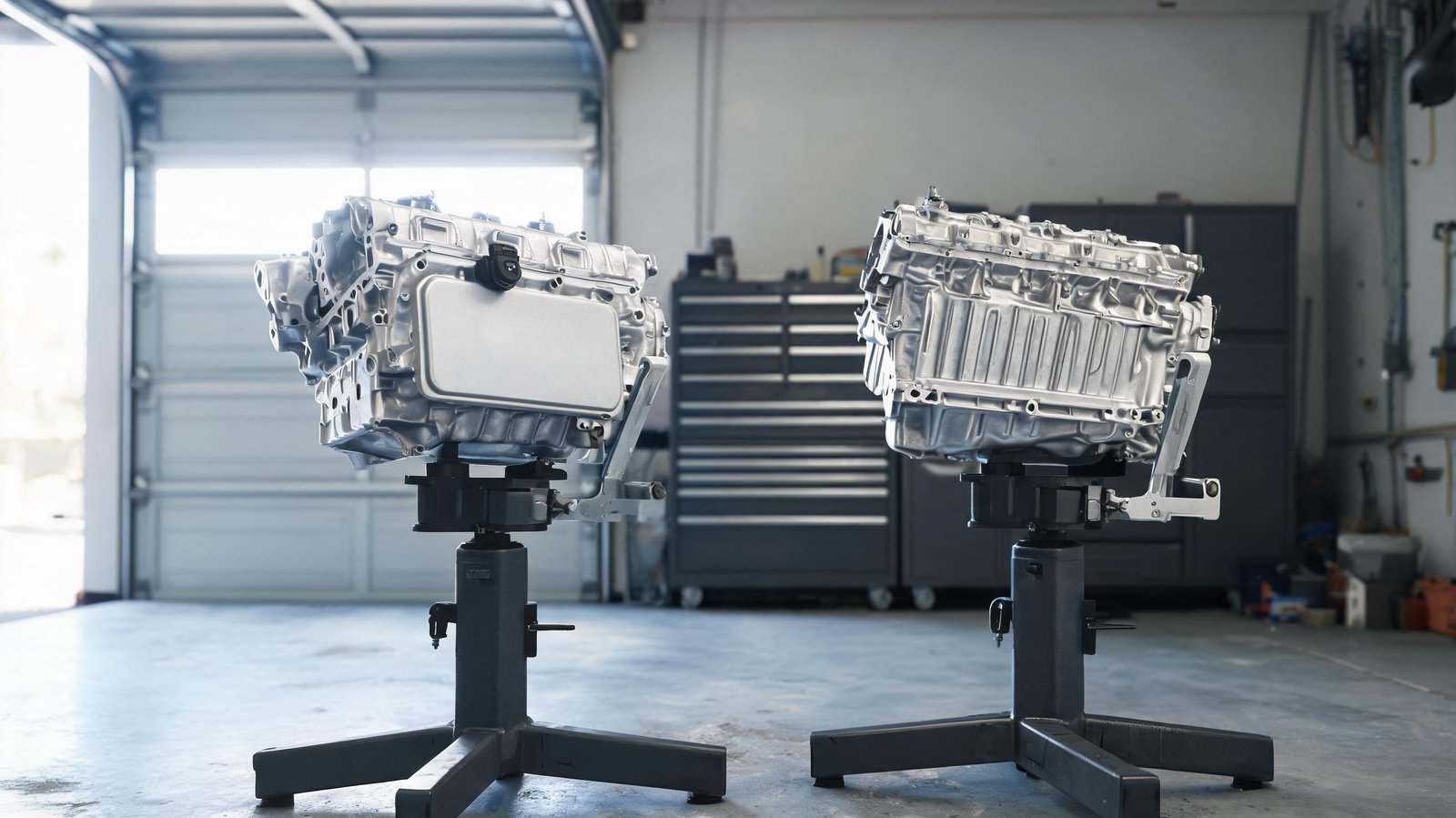
This is the heart of the whole subject. Two engines can carry the same displacement badge — 2.0 liters, 5.3 liters — and still refuse to swap cleanly, because the code versions were built for different installations. One carries the mounts for a transverse layout, the other for longitudinal. One has the sensor set for one emissions family, the other for the next revision. From the outside they look like cousins; on the stand they are different products.
Interchange lists — the trade's tool for safe fitment across years — are indexed by exactly this identifier. When our desk opens the list for your code, it is reading a verified map of which model years and platforms took that exact engine. That is how a replacement gets chosen without guesswork, and why we ask for the code before we ask about anything else.
| Detail that can differ between codes | Why it matters at install |
|---|---|
| Mounts and brackets | The wrong pattern does not bolt to your subframe — no adapter makes it right |
| Sump and oil pickup | Shapes vary by chassis; the wrong pan fouls the crossmember |
| Sensors and connectors | Different pinouts mean the harness does not plug in |
| Emissions hardware | The wrong package fails inspection and often the ECU's self-test |
| Calibration and software | ECUs are flashed for a family; mismatched hardware triggers fault codes |
| Intake and exhaust interfaces | Port and flange differences move the problem downstream |
Why can the same model take different engine codes?
Because model years, trims, emissions packages and markets all move the engine under an unchanged badge. A 2018 and a 2020 version of the same car can share a body and share almost nothing that bolts to the block.
Manufacturers treat an engine line like any other product: it gets refreshed. A mid-cycle update can swap the base engine for a new family, add a turbo variant above it, or retire a naturally aspirated option entirely — all under the same model name on the tailgate. Emissions rules add a second layer, because the same design can be certified in more than one configuration for different states and model years.
The result is the situation that confuses buyers most: a classified ad says 'fits 2015–2020', the buyer's car is a 2017, and the unit still does not fit — because the 2017 sits on the other side of an engine-generation change, or because this particular car was built with the optional engine while the listing came from the base one.
- Mid-cycle updates that swap or revise the engine family
- Trim levels running different engines in the same year
- Emissions packages certified separately by state and year
- Market-specific builds (fleet, export) that differ from retail cars
What goes wrong when you order by year or trim instead of the code?
You get a unit that matches the listing and not the car: the wrong mount pattern, the wrong sensor set, the wrong emissions hardware — discovered at the install, when return freight is already on your invoice.
The scenes repeat because the incentives repeat. A buyer filters a marketplace by year, sees a well-photographed engine, and buys the story instead of the specification. The block arrives, the shop lines it up, and the first bracket refuses to sit flat. That is the moment the order stops being a bargain: the unit has to come back out, the correct one has to be sourced, and every day between is downtime.
There is also a quieter version of the same mistake: ordering by the code you were told rather than the code you can see. Descriptions get copied from listing to listing, and a typo travels with them. The fix for both versions is identical — read the stamping yourself, photograph it, and let the desk confirm before anything moves.
| Item | Typical cost | Notes |
|---|---|---|
| Return freight, full engine | $250–$600 | Class and liftgate decide the number — paid twice per mistake |
| Shop remove-and-refit labour | $400–$900 | The second swap is pure loss |
| Vehicle downtime | $40–$90 per day | Rental or lost working days while the bay waits |
| Core handling friction | Varies | Mismatched paperwork complicates core credits |
| Code photo and desk confirmation | $0 | One photo session — the cheapest insurance in this trade |
What else does the engine code decide — price and warranty?
Condition-tier pricing runs on the code — a used unit and a remanufactured unit of the same code are different products at different prices — and warranty claims are filed against the code printed on the unit's label. Right code, clean pricing; right code, clean file.
Pricing in this trade moves with two axes: condition tier and code. The tier sets the finish — tested used, reconditioned with worn service parts replaced, or remanufactured rebuilt to specification — and the code sets which of those products even exists for your car. Some codes are everywhere and priced accordingly; others are scarce, and the desk will tell you plainly when one is.
Warranty works the same way. Claims are matched to the identifiers on the file: the code on the unit's label, cross-checked against the order and your VIN. When everything lines up, claims move — our team aims for a written decision within 48 hours of a complete file. When a claim arrives against a different code than the one that shipped, the first task becomes untangling what was actually installed, which serves nobody.
Engine code, engine number, fault code — how do the three differ?
The engine code names a design (B48). The engine number is the unique serial of one physical unit. A fault code like P0301 is a diagnostic message from the computer — not an identifier at all. Only the first one decides what fits.
The three live in different worlds and only overlap in conversation. The engine code is your ordering key. The engine number — stamped on the block and recorded on registration paperwork — is the unit's fingerprint, used for theft checks, insurance and resale. The fault code is the ECU talking: P0301 means cylinder 1 misfire, and it is a symptom description, not a part number. We cover what fault codes can and cannot prove in our P0301 misfire guide.
The mix-ups usually run one direction: someone reads a fault code and starts shopping, or quotes an engine number when asked for the code. Neither is a disaster — our desk sorts it out in a sentence — but knowing which identifier answers which question keeps every conversation moving in the right direction.
| Identifier | What it identifies | What it is used for |
|---|---|---|
| Engine code (B48, EA888, L83) | One engine design and version | Fitment, pricing, warranty on replacements |
| Engine number | One specific physical engine | Registration, insurance, theft checks, resale |
| Fault code (P0301, P0420) | A condition the computer detected | Diagnosis — points to a fault, not to a fitment |
What does a code look like across major brands?
Every manufacturer runs its own system: BMW's B48/B58/S58, Audi's EA888/EA839, GM's L-series and LT small-blocks, Ford's EcoBoost family and 5.0 Coyote, Toyota's 2GR line, Honda's K20-series, Hyundai and Kia's G4 family. The naming pattern changes; the role never does.
A few real examples from the codes we supply show the range. BMW's B48 four-cylinder appears across several models and years, with suffix revisions along the way. Audi's EA839 V6 spans platforms where mounts and ancillaries moved between applications. Ford's 5.0 Coyote and 7.3 Godzilla illustrate how one manufacturer can run an overhead-cam V8 and a pushrod V8 side by side — same brand, same trucks, completely different disciplines at the parts desk.
None of that variety is a problem, because the system is self-describing: whatever the pattern, the code on your block is the anchor. Our engine code index lists the codes we supply — more than 120 engine codes — each with fitment notes and pricing, so a five-minute lookup replaces an afternoon of guessing.
- BMW: B48 · B58 · S58 — family name plus revision suffix
- Audi: EA888 · EA839 — generation codes shared across platforms
- GM: L84 · L87 · LSY — displacement family with application codes
- Ford: EcoBoost family · Coyote · Godzilla — one brand, several naming eras
When does the code alone not settle fitment?
When the car has changed since the factory: engine swaps, a replacement head or cover that hides the original stamping, cross-market units, or heavy-duty variants that took a different build. In those cases the desk compares the code, the VIN and the wide photos together before quoting.
Swapped engines are more common than people assume — and they are not a problem in themselves. The problem is what they do to assumptions: the VIN decode describes the engine the factory installed, while the code on the block describes the engine that is actually there now. Both facts are useful; the desk just needs to hold them side by side instead of treating either as the whole truth. If you are weighing one yourself, our engine swap compatibility guide maps the three checks — mounts, electronics, emissions — in order.
The same applies to replaced covers — sometimes the sticker walks off with the old part, taking the easy answer with it. That is why our intake asks for the wide shot as well: it lets the desk confirm the pad being read is the block that is actually in the car, so the interchange list gets built on the engine in front of us, not the one in the paperwork.
How does the order actually work once the code is confirmed?
Send the code — a photo is fine — and the desk runs the interchange list, prices the nine options across three condition tiers and three warranty lengths, and confirms fitment before anything ships. Confirmation first, freight second.
The intake is deliberately small. Four photos cover it: the code close-up, the wide location shot, the door-jamb VIN label, and the odometer. From those, the desk decodes the build, confirms the code character by character, and opens the list of units that match — used, reconditioned and remanufactured, priced side by side so the trade-offs are visible instead of implied. If the VIN half of that photo set is new to you, our VIN engine identification guide explains the decode in plain terms.
If something in the photos is ambiguous — a faint stamping, a missing sticker — say so up front rather than guessing. The desk works with partial information all day and will tell you exactly what to photograph next. A five-minute call now is worth more than a confident guess that ships.
- Photograph the code close-up — raking light, every character
- Add the wide location shot — prove which pad this is
- Attach the VIN label and odometer photos
- Let the desk confirm the interchange and price the nine options
- Approve a unit — it ships labeled with the code and your VIN
What do we supply once your code is confirmed?
Used, reconditioned and remanufactured engines matched to your confirmed code — with transmissions on the same discipline — free insured freight USA-wide in 12–16 working days.
Everything ships from the same confirmed-code process. If you drive a BMW with the four-cylinder family, there is a used BMW B48 engine for sale and a remanufactured B48 engine for sale — same code, different finish, priced against each other. Mustang and F-150 owners shop the used Ford 5.0 Coyote engine for sale the same way, and Audi platforms run through a reconditioned EA839 engine for sale with the same code-first check.
Gearboxes follow the rule book: a used Ford F-150 transmission for sale or a reconditioned Ford F-150 transmission for sale ships against the same confirmed-code paperwork, alongside the rest of the transmission catalogue. Every engine leaves as a complete long block unless you specifically need a short block — compression-tested on the bench, and run-tested where the unit allows.
- Compression-tested on the bench — run-tested where the unit allows
- 9/16/36 months warranty, whichever comes first — by condition tier
- Code confirmed AND VIN cross-checked before dispatch — every order
- Free insured freight, USA-wide, 12–16 working days
- Fitment desk, Mon–Sat 8AM–6PM — answers before you order, not after
What does A2Z Engines check before dispatch?
The same four-step check on every order: read the code photos character by character, run the interchange list, cross-check the VIN, and label the unit with both identifiers. If a suffix looks wrong, the order pauses — every time, without exception.
The desk reads photos in a fixed order. First the close-up: every character of the stamped code, suffixes included. Then the wide shot, to confirm the pad is the pad. Then the VIN decode — what did the factory build? Only when those agree does the interchange list open and the nine options get priced. The pause on a mismatch is not friction; it is the whole service.
The textbook case from this month: a customer's code photo showed the earlier generation of Ford's 3.5 EcoBoost while his model year suggested the later one. The pause cost him an afternoon; the corrected order saved a full return cycle, because the two generations differ in turbo plumbing and mounting hardware. His replacement shipped labeled with the confirmed code and his VIN, and his shop verified the match on the stand in under a minute.
That is the design working as intended: the confirmation happens before the freight, and the label that carries it feeds everything after — including the warranty cover and the claim path if either is ever needed.
- Read the code photos — every character, suffixes included
- Run the interchange list — which years and platforms share this exact engine
- Cross-check the VIN decode — confirm the build the unit is going into
- Label and verify at dispatch — both identifiers on the unit and the file
What do these terms mean?
Plain-English definitions of every identifier and fitment term in this guide, so the next conversation about your engine sounds fluent from the first sentence.
Engine Code — The manufacturer's short identifier for one engine design and version (B48, EA888, L83); the ordering key for any replacement. Some registration paperwork calls it the engine code number — same identifier, longer name.
Engine Number — The unique serial of one physical engine, stamped on the block and recorded on registration paperwork; used for identity and theft checks rather than fitment.
Fitment — Whether a specific engine will install and run correctly in a specific vehicle — decided by the code first, cross-checked against the VIN.
Interchange List — The verified map of model years and platforms that share the same engine; the desk's tool for safe fitment across years.
Build Sticker — The factory record of what one vehicle was built with, including the engine; often replicated on glovebox labels like GM's RPO list.
Machined Pad — The flat machined surface on the block where the engine code is stamped; read it with light raking across the characters.
Long Block / Short Block — What a replacement includes. A long block arrives as a complete engine assembly; a short block is the block with internals, without the top end and ancillaries.
Where do these figures come from, and where can I verify them?
The checks and price ranges follow standard trade practice and the public resources below. You can verify the background yourself:
Ranges are typical US independent-workshop figures and our own condition and warranty tiers — planning guidance, not a quote for your vehicle. A2Z Engines is the trading brand of QB AUTOZ LLC, a Mississippi-registered supplier — the company record is on our about page.
- NHTSA VIN decoder — decode your exact build and engine family by VIN
- EPA vehicle and fuel emissions testing — how emissions rules create engine variants within one family
- FuelEconomy.gov — official data that distinguishes drivetrain and engine configurations
- NHTSA recalls — check open recalls for your vehicle by VIN
- Engine code index — our own lookup of the codes we supply, with prices
Which related guides should I read next?
These are the guides we hand to customers at the end of this conversation — each one picks up a thread from this post and finishes it.
- Engine Code vs VIN: What's the Difference? — the two identifiers side by side, in one table.
- How Do I Find My Engine Code? — the five-minute routine for locating the code on any car.
- What Does a P0301 Misfire Code Actually Prove? — the third kind of code, and what it can and cannot tell you.
- Explore the site: shop by make · engine code index · used engines · transmissions — every unit fitment-checked before dispatch.
- Ready for numbers? Get your price — nine options across three condition tiers — or search the full catalogue; more guides live on the blog index.
Frequently asked questions
What is an engine code in simple terms?
It is the manufacturer's short name for one exact engine design and version — B48, EA888, L83, 2GR-FKS. It is stamped on the block and repeated on build stickers, and it is the identifier a supplier uses to decide which replacement engines fit your car, what they cost, and what the warranty covers. The model year narrows the field; the engine code pins it. That is the engine code meaning, nothing more mysterious.
Where can I find the engine code on my car?
Start with the machined pad on the cylinder block — a phone flashlight held at a low angle makes the stamping readable. Cross-check with the sticker on the engine cover or timing cover, and the glovebox build sticker on many makes. Our walkthrough guide, How Do I Find My Engine Code?, covers the routine make by make in about five minutes.
Does the engine code alone decide fitment?
It decides the design and the interchange list, which is 90 percent of the question — but a serious seller confirms it against your VIN as well. The code catches the engine; the VIN catches the build, including emissions and market differences. Our desk runs both keys on every order, which is why a confirmed-code order rarely comes back.
Can the same car model have more than one engine code?
Yes — routinely. A mid-cycle update can swap or revise the engine family under an unchanged badge, trims can run different engines in the same year, and emissions packages are certified separately by state and model year. That is why a listing claiming 'fits 2015–2020' can still hand you a unit that does not fit a 2017 — the year range is not the specification.
What is the difference between an engine code and an engine number?
The engine code names a design — every B48 built to that pattern shares it. The engine number is the unique serial of one physical unit, stamped on the block and recorded on registration paperwork. Codes decide what fits; numbers identify what you own, for registration, insurance, theft checks and resale.
What if I cannot find the code — is the VIN enough?
The VIN gets you close: a decode through the NHTSA VIN decoder returns the engine family your car was built with. What it does not hand you is the full stamped code with its version suffix. If the pad is unreachable or the characters are worn, send everything you have — the VIN label, the wide engine shot, any sticker photos — and the desk works from all of it together.
Can I install a different engine code than my car came with?
Sometimes, with planning — swaps happen, and the VIN decode versus the block stamping is exactly how the difference gets caught and handled. But a swap is an engineering project, not a parts order: mounts, sensors, wiring and calibration all come along for the ride. Send photos of the car and the candidate engine; the desk will tell you plainly whether the pairing is realistic.
Do used and reconditioned engines follow the same code rule?
Yes — the code requirement is identical across all three condition tiers. A used unit, a reconditioned unit with worn service parts replaced, and a remanufactured unit rebuilt to specification are all confirmed against the same code, then cross-checked against your VIN before dispatch. The tier changes the finish and the warranty length, never the fitment discipline.
What if the sticker and the block stamping disagree?
Treat it as a pause, not a puzzle to solve by picking a favorite. Disagreement usually means a replaced cover — stickers travel with parts — or a swapped engine. Both are common and checkable: send both photos plus the wide location shot, and the desk resolves it with the same three-way check it runs before dispatch. Solving it properly is what keeps the order correct.
How fast can I get a price once I send the code?
Usually within the same business day, often faster. The desk confirms the code against the interchange list, cross-checks your VIN, and sends nine options — three condition tiers across three warranty lengths, priced side by side. Send your code photo through the quote page or call the fitment desk, Mon–Sat 8AM–6PM.
What warranty comes with a replacement engine?
Every tier carries cover: 9 months on used, 16 on reconditioned, 36 on remanufactured — 9/16/36 months, whichever comes first. Warranty starts at delivery, and claims get a written decision within 48 hours of a complete file. The file starts with the same identifier this guide is about — your engine code — matched on the unit's label. Full terms live on the warranty page.
Check your fitment and see nine price options
Enter your VIN or engine code — we match the unit to your vehicle before any price is shown. Nine options means three condition tiers across three warranty lengths.
Get my price Call +1 (662) 452-4928